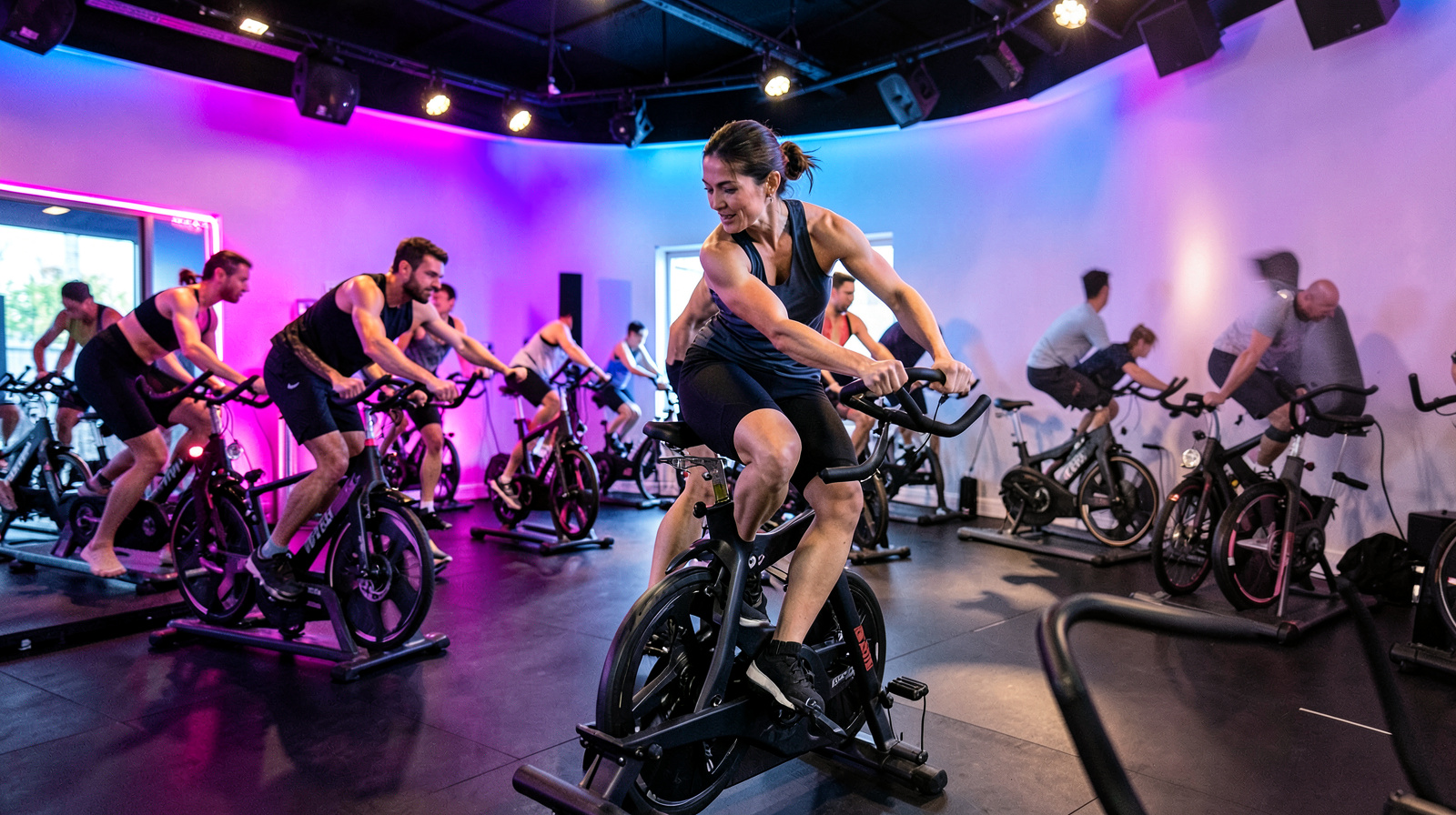
Members notice the moment the music stops. Here is what research says about music and exercise, how to program each zone of your gym, and the licensing rules for classes that trip up many clubs.
In a gym, music is not decoration. Members notice the second it stops. That makes music one of the few amenities nearly every member experiences on every visit, and one of the easiest to get wrong, both on the floor and on paper.
This guide covers what research says about music and exercise, how to program each zone, how loud is too loud for your staff, and the licensing rules for fitness classes that many clubs misunderstand.
Why music matters in a gym
The broadest summary of the evidence is a 2020 meta-analysis in Psychological Bulletin by Peter Terry, Costas Karageorghis and colleagues (abstract on PubMed). It pooled 139 studies with 3,599 participants. Listening to music during exercise and sport was associated with more positive feelings, better physical performance, lower perceived exertion and slightly more efficient oxygen use. It had no significant effect on heart rate. Performance effects were larger for exercise than for competitive sport, and larger with fast-tempo music than with slow-to-medium tempo.
For a gym owner, that supports two practical conclusions. First, music is a real part of the product, not a nice extra. Second, what helps depends on the activity: tempo that suits a spin class would be wrong for a stretching area.
Match the music to each zone
- Front desk and lobby: welcoming and upbeat at a moderate level. This is the first impression, and staff need to hear members at the desk.
- Cardio floor: steady, driving rhythm. Many cardio users wear their own headphones, so overhead music is a backdrop; keep it consistent rather than loud.
- Free weights and functional training: the highest energy in the building, with a strong beat. Our workout collection and the energetic mood collection are good starting points, and house tracks with a steady four-on-the-floor pulse work well for circuits.
- Stretching, mobility and recovery: slow things down. Calm, spa-style and ambient music, such as our spa collection, helps people shift out of training mode.
- Locker rooms: low and neutral.
- Group studio: programmed class by class, usually by the instructor. That is where licensing gets complicated, so it has its own section below.
A useful trick: many track listings in the WeavyAudio catalog show the tempo in beats per minute, which makes it easier to keep a zone's energy consistent.
Programming a class: follow the energy curve
Most instructor-led classes share the same shape, and the music should follow it:
- Warm-up: moderate tempo, positive mood, no sudden drops.
- Build: raise tempo and intensity gradually over several tracks.
- Peak blocks: the fastest, most driving tracks for the hardest intervals.
- Recovery intervals: short dips in energy between peaks.
- Cool-down and stretch: slow, calm and noticeably quieter.
Avoid tracks with long, quiet intros that stall a class, and keep lyrics clean in facilities that welcome teens or families. Whatever the source, the licensing questions below still apply.
Licensing: the part many clubs get wrong
A gym is a place open to its members, so music played there is a public performance under U.S. copyright law. Performing rights organizations license fitness facilities, and BMI's fitness and health club licensing page is a clear example of how it works:
- What it covers: group fitness classes (aerobics, spinning, kickboxing, dance and similar), ambient background music in training areas, locker rooms and relaxation spaces, and music on TVs in common areas.
- How the fee is set: based on the number of members and how music is used. If several categories apply, the higher per-member fee is used, and fees adjust each year with the Consumer Price Index.
- Renewal: the license runs for a year and renews automatically unless cancelled with 30 days' written notice.
ASCAP offers its own license for fitness facilities, and SESAC and GMR license their repertoires separately. A license from one organization only covers its own members' music.
BMI's FAQ also answers three common questions:
- Do the fitness mixes we buy include performing rights? No. BMI says purchasing audio files designed for health club use, or subscribing to streaming services, does not include U.S. performing rights.
- Aren't instructors responsible for their own music? No. BMI says the club benefits from the music, so the club is responsible, even when instructors are independent contractors.
- What about classes streamed online? Video-conferencing platforms generally do not hold a blanket license with BMI, so online classes need their own digital license, which BMI offers for live streaming and on-demand classes.
Where WeavyAudio fits, and where it does not
WeavyAudio can be the source for your background music. The catalog is original and owned by WeavyAudio, so there are no PRO royalties for that music, and your subscription includes a license to publicly perform it at your registered location.
Two honest limits. Our Terms of Service describe the permitted use as background music playback at the licensed location during operating hours, so if you want to use the catalog as the main soundtrack for instructor-led classes, confirm with us at support@weavyaudio.com before relying on it. And the terms do not allow re-broadcasting, so streaming or recording classes online with our music is not covered. Instructors' own playlists from personal apps are not covered by anything we provide either; those need PRO licenses and a source whose terms allow business use.
Volume: protect your members and your team
Instructors and floor staff can spend many hours a week in loud rooms. OSHA's guidance on occupational noise offers a simple field test: if you need to raise your voice to speak to someone three feet away, noise levels might be over 85 decibels. The same page notes that NIOSH recommends keeping worker exposure below the equivalent of 85 dBA over an eight-hour day.
Practical steps:
- Check levels with a sound level meter or a phone app in each zone, at busy and quiet times.
- Keep background zones clearly below class volume.
- Give instructors a headset microphone so they do not compete with the music.
- Agree on a maximum setting for the studio and write it down.
A simple weekly music plan
- Early morning: energetic but not aggressive; people are waking up.
- Midday: steady and upbeat for lunchtime regulars.
- Evening peak: the highest energy of the day on the weights floor.
- Late evening: taper the tempo as the gym empties.
- Weekends: vary the rotation; different crowds train at different times, and your staff will appreciate the change.
If you would like a single, documented source for background music across your floor, locker rooms and recovery areas, you can start a WeavyAudio free trial and hear it on your own floor this week.
FAQ
Do gyms need a music license?
Yes. Music played in a gym is a public performance. Clubs usually need licenses for the PRO repertoire they play, or a music source whose licensing covers the specific use, and background music and classes can be treated differently.
Are fitness instructors responsible for music licensing?
BMI's position is that the club is responsible for classes at the club, even if instructors are independent contractors. For instructors teaching online outside a club, BMI offers a separate digital license.
What tempo is best for workout music?
It depends on the activity. The 2020 meta-analysis found larger performance benefits with fast-tempo music, so use it for cardio and training, and slower music for warm-ups, stretching and recovery.
Does buying fitness music mixes cover public performance?
Not according to BMI, which says purchased audio files designed for health club use and streaming subscriptions do not include U.S. performing rights.
Can I stream my classes online with WeavyAudio music?
No. Our terms do not allow re-broadcasting or recording the music, so online and on-demand classes are not covered.