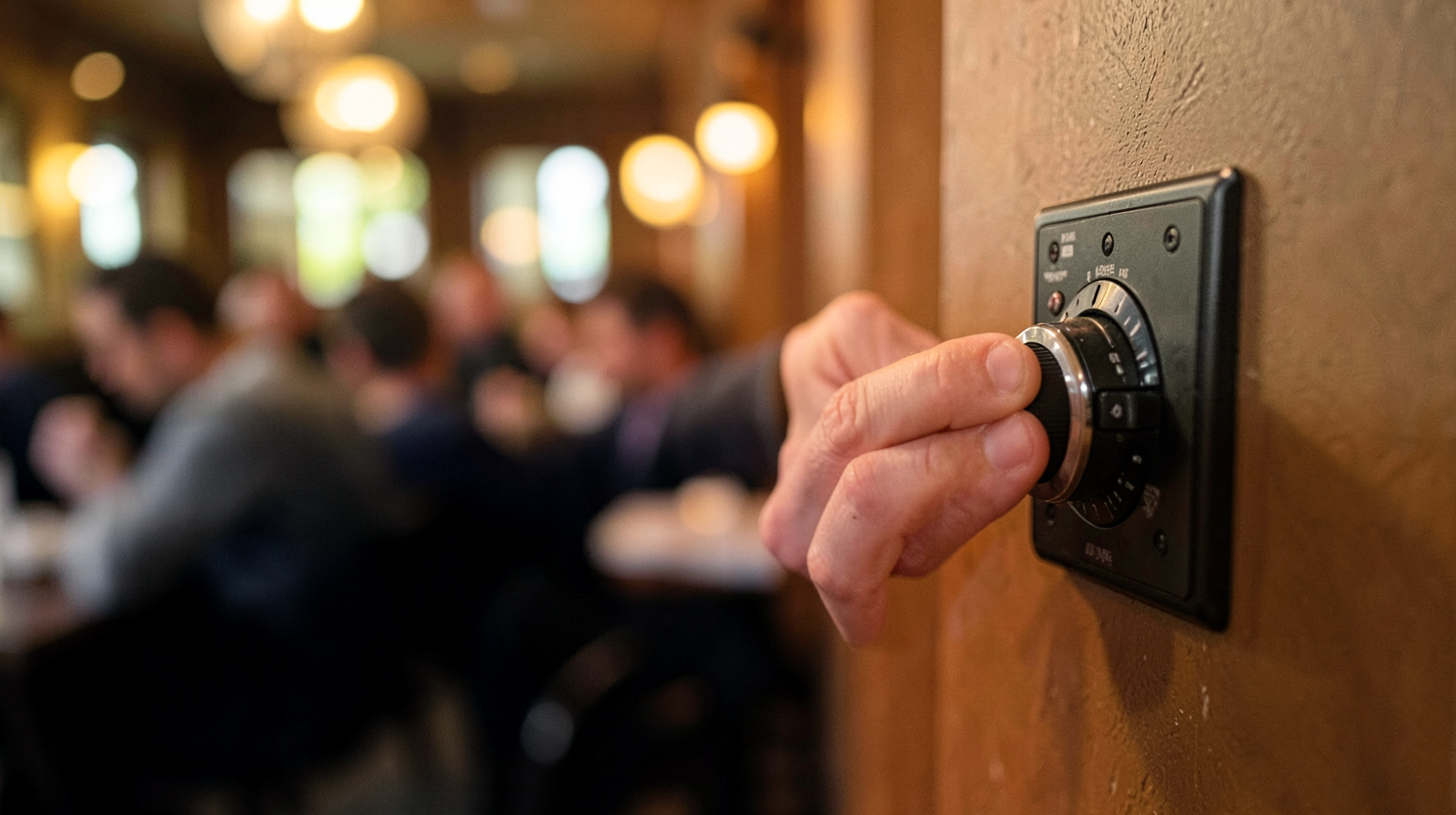
Volume ruins more venue soundtracks than bad song choices do. Here is a practical way to set levels by occupancy, protect your staff, and plan music that follows the clock, with daypart templates for cafés, restaurants, hotel lobbies and shops.
Plenty of venues choose good music and then play it at the wrong level. Music that is too loud makes people raise their voices and can cut visits short. Music that is too quiet leaves a room feeling empty and every clatter from the kitchen exposed. Getting the level right, and changing it as the day changes, is the most underrated skill in running a venue's sound.
This playbook gives you a simple way to set volume, explains why it matters for staff as well as guests, and lays out daypart templates for cafés, restaurants, hotel lobbies and shops.
The short answer
Background music should be loud enough to take the edge off silence and quiet enough that two people at the same table or counter can talk at a normal voice without leaning in.
There is also a safety ceiling, mainly for your staff. OSHA's page on occupational noise offers a practical test: if you need to raise your voice to speak to someone three feet away, noise levels might be over 85 decibels. The same page notes that NIOSH recommends keeping worker exposure below the equivalent of 85 dBA over an eight-hour day, and that OSHA requires hearing conservation programs when workers' average exposure reaches 85 dBA over an eight-hour shift. A background music system should never be the reason your room gets anywhere near that.
Why volume matters more than most owners think
- Conversation is the product. In restaurants, cafés, salons and lobbies, people come to talk. Music that forces raised voices makes the whole room louder, because everyone talks over everyone else.
- Volume changes behavior. In a 1966 supermarket study summarized by Ronald Milliman, shoppers spent significantly less time in stores during loud music sessions. In a small 2008 field experiment with 40 male beer drinkers (Guéguen and colleagues), louder music led patrons to drink more and finish each glass faster. Neither is a reason to crank the volume; both are reminders that volume is not neutral.
- Your staff are there all day. A level that feels lively for a one-hour dinner is a long day's exposure for a server or barista.
How to set volume in 15 minutes
- Get a meter. A basic sound level meter or a sound level app on your phone is enough for relative comparisons. OSHA notes that phone apps are among the tools available for measuring workplace noise.
- Measure where guests sit, not beside a speaker or behind the bar. Take readings at three or four seats in each zone.
- Do it three times: empty, half full and full. The right music level changes as crowd noise rises.
- Run the conversation test at each stage. Two people at a table should be able to talk at a normal voice.
- Write down the settings. Note the system volume for each occupancy level and each zone, and post it where the manager on duty can see it.
- Recheck after changes. New speakers, furniture, rugs or a new patio all change how a room sounds.
- Assign ownership. One person per shift controls the volume. Everyone else can ask.
A useful rule of thumb: as the room fills, raise the music less than the crowd noise rises. The busier the room, the more the music should step back.
Five common volume mistakes
- Setting the level in an empty room before opening and never touching it again.
- Measuring next to a speaker instead of at the seats where guests actually sit.
- Letting the loudest zone set the level for everyone, such as the bar deciding for the dining room.
- Using volume to fix the wrong music. If a track feels flat, change the track rather than turning it up.
- Forgetting the patio. Outdoor speakers carry to neighbors and the street, and local noise rules vary, so check yours.
Dayparting: sound that follows the clock
Dayparting means dividing your opening hours into blocks and giving each one its own energy, tempo and volume. The same room feels different at 8 a.m. and 8 p.m., and the music should too.
Three rules make dayparting work:
- Move gradually. Change energy over ten to twenty minutes instead of jumping between extremes. Gapless playback helps transitions sound intentional.
- Change one thing at a time. Shift tempo first, then style, then volume, so guests feel a gentle drift rather than a switch.
- Plan around your real traffic, not an idealized day. Look at when you actually get busy.
Café or bakery
- Opening to mid-morning: bright and positive, from our morning collection, at a moderate level.
- Late morning: calmer and steadier for people working or meeting.
- Lunch: a little more warmth and movement.
- Afternoon: mellow and unhurried, from the mellow mood collection, slightly lower.
Restaurant
- Lunch: moderate tempo, light and clear.
- Early dinner: warm and relaxed as the first tables arrive.
- Peak: a touch more energy, but volume capped so conversation stays easy.
- Last seatings: slower and softer, from our late night collection, to signal the evening winding down.
Hotel lobby
A lobby is a pass-through, a meeting place and often a bar, all in one space.
- Breakfast and check-out: calm, fresh and quiet enough for front-desk conversations and phone calls.
- Midday: unobtrusive instrumental music for guests working or waiting.
- Check-in rush: a little more warmth and energy to make arrivals feel welcome.
- Evening bar: lounge textures and soft grooves, slightly fuller but still conversational.
- Late night: low and minimal. Guests coming and going should hear a calm building.
Retail store
- Opening hours: relaxed, to encourage early browsers to take their time.
- Peak hours: steady mid-tempo that keeps the floor flowing without feeling rushed.
- Last hour: calmer and a little quieter as the store empties.
Who controls the music
Most volume problems are really ownership problems. A server turns it up for a birthday table and nobody turns it down. A new hire plugs a phone into the house speakers. Write a short music policy:
- One person per shift controls volume and playlist changes.
- The daypart schedule and volume settings are posted where that person can see them.
- Staff can request changes and flag tracks, but they do not bring personal devices.
- Special events get a written plan, including when the room returns to normal.
A system you can adjust from your phone makes this easier. WeavyAudio lets you change the vibe from your phone, plays gaplessly all day without anyone touching it, and gives you playlists by genre and mood to build each daypart from; our playlists page is a quick way to hear them. If you want to set up a full day of dayparts for your venue, you can start a free trial and have it running before tomorrow's opening.
FAQ
What decibel level should background music be?
There is no single correct number, because rooms and crowds differ. Use the conversation test at guests' seats, and keep staff exposure well below the level NIOSH recommends as a limit, 85 dBA averaged over eight hours.
Should music get louder as a restaurant fills up?
A little, but less than the crowd noise rises. If guests start raising their voices, the music is part of the problem.
What is dayparting in music?
Dayparting is planning different music for different parts of the day, adjusting energy, tempo and volume to match what happens in the room at each hour.
How many dayparts do I need?
Most venues do well with four or five blocks that follow their real traffic, such as opening, lunch, afternoon, evening peak and closing.
What music works in a hotel lobby?
Calm, mostly instrumental music during the day, warmer and slightly fuller music for the evening bar, and low, minimal music late at night, always quiet enough for front-desk conversations.