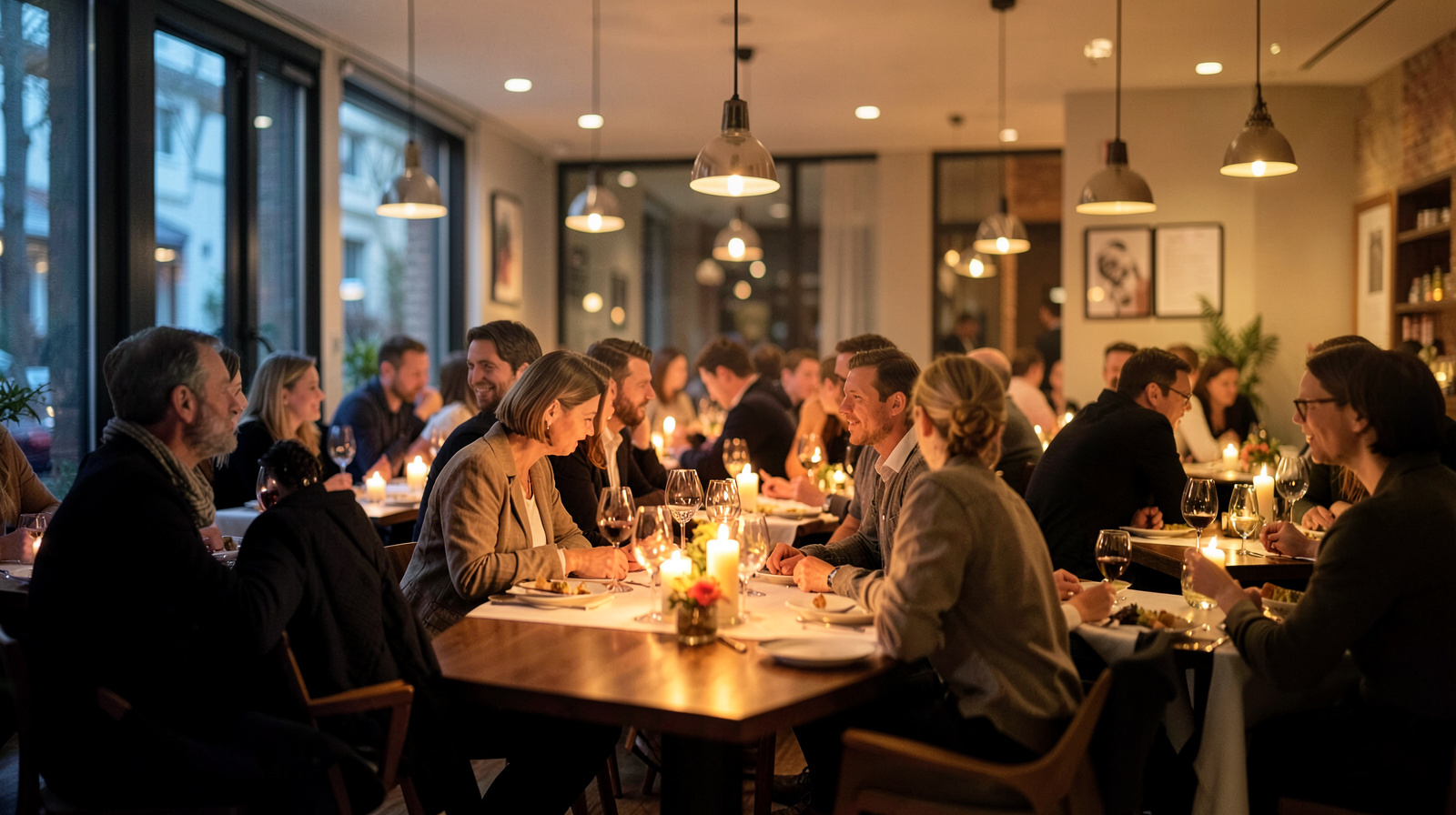
The right restaurant music depends less on taste and more on your concept, your service rhythm and your room. Here is a practical framework, what the research on tempo and spending really found, and four playlist blueprints.
Guests rarely comment on a restaurant's music when it is right. They notice immediately when it is wrong: too loud to talk over, too frantic for a slow dinner, too sleepy for a busy lunch. Music is part of the room, like lighting and chairs, and it deserves the same deliberate choices.
The good news is that you do not need to be a DJ to get it right. You need a clear idea of your concept, a map of your service rhythm and a few rules about volume and vocals. This guide covers all three, looks at what research on restaurant music actually found, and ends with four playlist blueprints you can adapt.
Start with your concept, not with a genre
Before choosing a single track, answer five questions:
- What is your price point and pace? A fast-casual counter and a tasting menu need different energy.
- How long do you want guests to stay? Longer stays can mean more drinks and desserts; faster turns matter when there is a line.
- Who is your core guest? Age, occasion and whether they come to talk, to work or to celebrate.
- What does the room sound like empty and full? Hard surfaces and high ceilings amplify everything, including music.
- How long are your staff shifts? Your team will hear the playlist far more often than any guest.
With those answers, broad directions become clear:
- Quick-service and fast casual: bright, mid-to-upbeat, vocals are fine, energy that supports quick decisions.
- Casual full-service: warm and familiar-feeling, such as soul, funk, acoustic and indie at moderate tempo.
- Fine dining: mostly instrumental, piano, strings or classical, low volume and very few surprises.
- Brunch: light, sunny and acoustic, with enough energy for a lively room.
- Wine bar or late-night kitchen: lounge, soft grooves and deeper electronic textures kept low in the mix.
What the research says about tempo and style
Two restaurant studies are frequently cited on this topic, and both are worth knowing in detail rather than as headlines.
In 1986, Ronald Milliman published a field experiment run in a medium-sized restaurant in the Dallas-Fort Worth area (Journal of Consumer Research). On Friday and Saturday evenings over eight weekends, the restaurant played instrumental music that diners perceived as either slow (72 beats per minute or fewer) or fast (92 or more). With slow music, groups stayed at their tables for 56 minutes on average versus 45 with fast music, and bar purchases per group were higher, $30.47 versus $21.62. Food spending barely moved, $55.81 versus $55.12, a difference that was not significant. There was also a trade-off: the average wait for a table rose from 34 to 47 minutes, most likely because tables turned more slowly.
In 2003, Adrian North, Amber Shilcock and David Hargreaves compared classical music, pop and no music over 18 evenings in a British restaurant (Environment and Behavior). Classical music led to higher total spending per head than either pop or silence.
Both are single-venue studies, and the Milliman prices are from the 1980s. Treat them as well-designed hypotheses to test in your own room, not as guarantees. The practical lesson is still useful: calmer, slower music tends to support lingering, and brisker music tends to support turnover. Choose based on what your restaurant needs at that hour.
Map the music to your service rhythm
Most restaurants have five or six distinct moments in a day. Plan each one.
- Opening: set the tone gently. Guests arriving to an empty room should hear warmth, not a party.
- Lunch: moderate tempo and a little brightness to keep the room moving.
- Afternoon lull: mellow and unhurried. This is when repetition is most noticeable, so rotate.
- Dinner build: warm, mid-tempo and slightly richer in texture as the room fills.
- Peak: a touch more energy, with volume rising less than the crowd noise does.
- Last seatings: slower and softer. Music is one of the gentlest ways to signal the end of the night.
Change between these moments gradually, over ten to twenty minutes, rather than with an abrupt switch.
Four playlist blueprints
These use collections from the WeavyAudio catalog, but the logic works with any licensed source.
The neighborhood brunch spot
Lead with acoustic and morning tracks: light guitars, soft vocals and an easy, positive feel. Lift the tempo slightly around the late-morning peak, then ease back down as the room clears.
The casual dinner place with a bar
Build the core from soul, funk and our dinner collection for the main service. After 9 p.m., let the bar area drift toward deeper grooves such as deep house at low volume, which keeps energy up without taking over conversation.
The fine dining room
Keep it instrumental and consistent. Our piano collection, along with strings and classical, suits a room where conversation and the food are the show. Avoid tracks with sudden loud passages; a quiet dining room makes every jump obvious.
The wine bar or late-night kitchen
Lounge textures and our late night collection work well here. Keep vocals sparse and the volume just above the room's natural murmur.
Details that separate good from great
- Vocals compete with conversation. Lyrics pull attention away from the table. At dinner, lean instrumental or choose tracks where vocals sit low.
- Measure volume at a table, not at the bar. Walk the room when it is empty, half full and full. If two guests at the same table have to raise their voices to talk, it is too loud. OSHA notes that needing to raise your voice to speak to someone three feet away can mean noise levels above 85 decibels.
- Zone the room. A bar, a dining room and a patio rarely want the same level or even the same music.
- Protect your team. A track that is charming once is grating on the fortieth play. Keep a shared skip list and refresh the rotation regularly.
- Watch the transitions between genres. Jumping from a slow ballad to a fast dance track reads as a mistake. Plan the order within each daypart.
- Keep it licensed. Personal streaming accounts are for personal use only, and Spotify's support pages name restaurants specifically. Use a source licensed for business playback.
A simple weekly routine
- Monday: review staff feedback, remove anything flagged and add a few fresh tracks.
- Midweek: spot-check volume at lunch and at the dinner peak.
- Friday: confirm the weekend's late-night blocks and any event changes.
- Every quarter: revisit the five concept questions. Menus, seasons and crowds change, and the music should follow.
If you would like to hear how these blueprints sound in your own dining room, you can start a WeavyAudio free trial and run a week of dinner service with it.
FAQ
What is the best background music for a restaurant?
The best music fits your concept and your pace at each hour. Fine dining usually suits instrumental piano, strings or classical; casual spots suit warm soul, funk, acoustic or indie; late-night rooms suit lounge and deeper grooves at low volume.
Should restaurant music have lyrics?
Some can, especially at brunch or in casual rooms. During dinner service, instrumental music or tracks with understated vocals compete less with conversation.
What tempo should restaurant music be?
It depends on your goal. In Milliman's 1986 study, diners perceived 72 beats per minute or fewer as slow and 92 or more as fast; slow music was linked to longer stays and higher bar spending but also longer waits for tables.
How loud should music be in a restaurant?
Loud enough to soften silence, quiet enough that two people at the same table can talk at a normal voice. Check at seating positions as the room fills, and lower it if guests start raising their voices.
Can I play Spotify in my restaurant?
Not with a personal account. Spotify's terms limit it to personal, non-commercial use, and its support pages list restaurants as places where it cannot be played publicly.