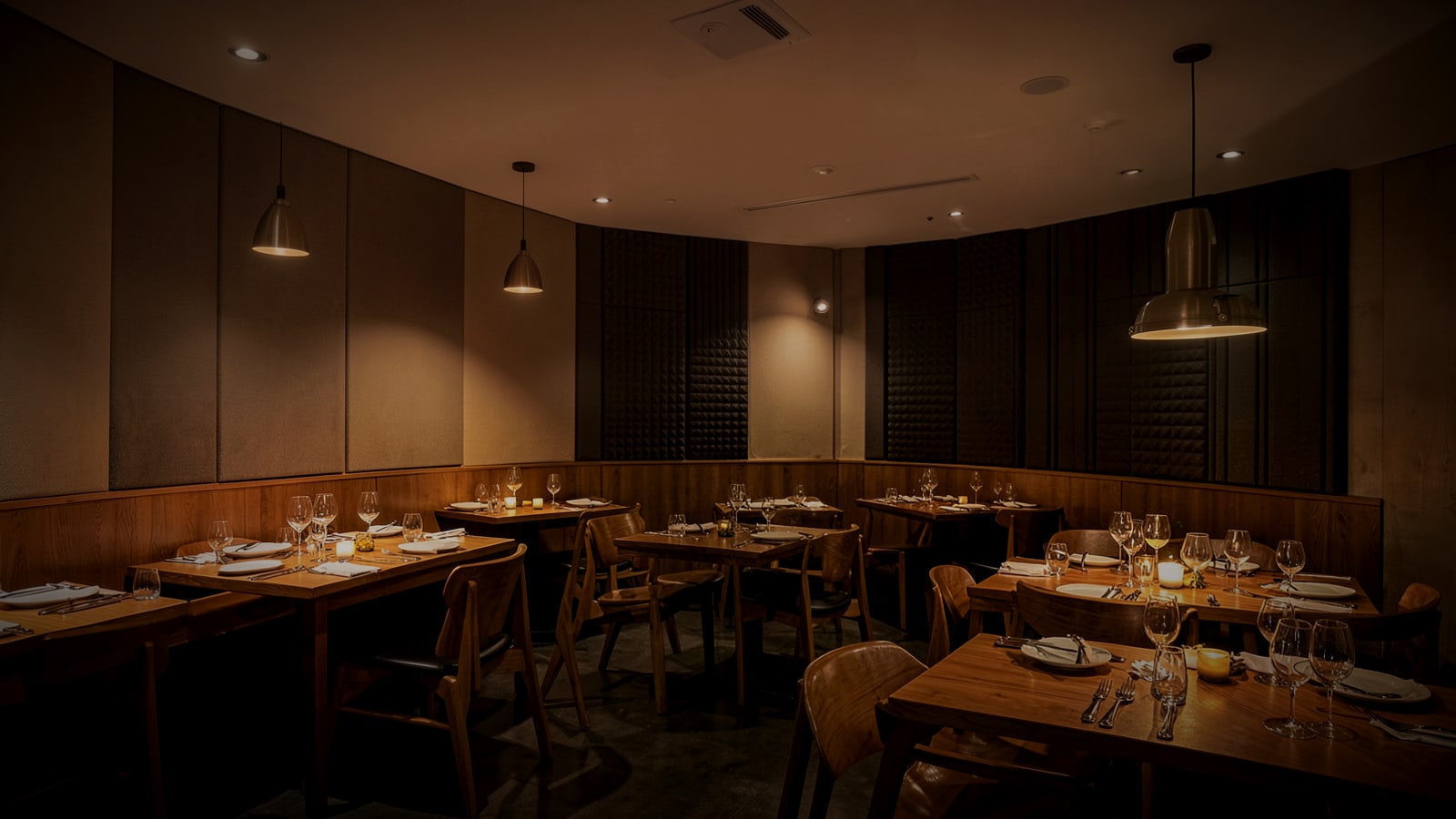
Most restaurant music problems are sound system problems: two loud speakers blasting one corner, a patio nobody can hear, a bar that drowns the dining room. Here is how to plan speakers, zones, amplification and acoustics so music feels even, controllable and comfortable.
You can pick the perfect playlist and still have guests complain that the music is too loud, too quiet or oddly muffled. In most dining rooms the problem is not the music. It is the restaurant sound system: too few speakers turned up too high, speakers pointed at the wrong places, one volume knob for three very different areas, and hard surfaces bouncing everything back.
This guide explains how to plan a system that sounds even and comfortable, whether you are fitting out a new space or fixing an old one. It is brand-neutral on purpose. The principles matter far more than the logo on the grille.
The goal of a restaurant sound system
A background system is not a nightclub rig. Its job is to deliver music at a consistent, modest level everywhere guests sit, so that no table is blasted and no corner is dead, while leaving room for conversation. That leads to one core principle: many small speakers at low volume beat a few big speakers at high volume.
Two loud speakers in the corners have to be turned up to reach the middle of the room, which makes the tables next to them unbearable. Spread the sound across more, smaller sources and every seat gets roughly the same level at a lower volume per speaker.
How many restaurant speakers do you need?
There is no universal number, because it depends on ceiling height, room shape and speaker coverage. A few rules of thumb used by installers:
- Lower ceilings need more speakers. A ceiling speaker spreads sound in a cone. The lower the ceiling, the smaller the circle it covers at seated ear height, so you need them closer together.
- Aim for overlapping coverage. Guests sitting between two speakers should hear both, not a gap.
- Treat every distinct area separately. Bar, dining room, patio, restrooms and entrance each need their own coverage plan.
- Ask for a coverage layout. A competent installer will mark proposed speaker positions on your floor plan and explain the spacing. If they cannot, find another installer.
Ceiling, pendant or surface-mounted?
Speaker placement in a restaurant starts with the type of speaker your ceiling allows.
- In-ceiling speakers: the default for drop ceilings and drywall. Discreet, even coverage, easy to space in a grid.
- Pendant speakers: hang from high or open ceilings, common in industrial-style spaces. They bring the sound down closer to guests so you do not have to crank the volume to reach from a high roof.
- Surface-mounted speakers: bracketed on walls or beams. Useful for bars, odd-shaped rooms and patios. Point them at seating areas, not at hard walls or directly at a nearby table.
- Outdoor-rated speakers: patios need weather-resistant models. Aim them inward toward your guests and away from neighbors.
- Subwoofers: optional for background music. One small, well-placed unit adds warmth; too much bass carries through walls and tires staff over a shift.
Zones: the most important decision
A zone is an area whose volume, and sometimes source, you control independently. Without zones you are forced to choose one setting for the whole building, which never works.
A typical restaurant audio system might have:
- Dining room: lowest, most consistent level.
- Bar: a little livelier, especially later in the evening.
- Patio: separate level to cope with street noise and neighbors.
- Restrooms: low, mainly to cover sound, often the same source as the dining room.
- Entrance or waiting area: enough to create atmosphere from the doorway.
- Private dining room: its own level and, ideally, its own source so events can play their own program or nothing at all.
Kitchens and back-of-house areas are usually better without the front-of-house feed. Staff need to hear tickets, timers and each other.
Amplifiers and system types
A commercial sound system for a restaurant is usually built around one of two approaches.
- Constant-voltage systems (often called 70-volt or 100-volt): common in commercial installations because many speakers can be run on long cable runs from one amplifier, with each speaker tapped to a chosen power level. Well suited to larger rooms with many ceiling speakers.
- Low-impedance systems: the kind used in home audio and small venues. Fine for a few speakers close to the amplifier, but less flexible as the number of speakers grows.
Whichever you choose, get an amplifier or mixer amplifier with enough zone outputs for your plan and some headroom, so it is never running near its limit. Put it somewhere ventilated, not in a hot closet next to the dishwasher.
Volume control your staff will actually use
The best designed system fails if the only volume control is on a rack in the office. Plan controls for the people who adjust the music every night:
- Wall volume controls in each zone, clearly labelled.
- Maximum limits set by the installer so no zone can be pushed past a sensible level.
- A simple routine: one person owns the music each shift, and there is a written rule for when it changes, for example after the dinner rush.
Our guide on how loud background music should be explains the conversation test for setting levels. Remember that restaurants are workplaces: OSHA requires a hearing conservation program when employee noise exposure reaches 85 dBA as an eight-hour time-weighted average, and a busy room plus loud music can push staff toward that level.
Restaurant acoustics: the half of the problem speakers cannot fix
Many modern dining rooms are built from hard surfaces: concrete, glass, tile, exposed brick, metal chairs. Sound bounces around, conversation gets louder to compensate, and the music is turned up to be heard over the conversation. Better speakers alone cannot solve that.
Restaurant acoustics improve with absorption:
- Acoustic ceiling panels or baffles: usually the most effective single change, because the ceiling is often the largest untreated surface.
- Wall panels: fabric-wrapped panels, acoustic art prints, felt slats or upholstered banquettes.
- Soft furnishings: curtains, cushioned seating and rugs in lounge areas all help.
- Underside treatments: felt pads under tables and chairs cut scraping noise.
A room with less echo lets you run music at a lower level while guests hear it more clearly, which is the whole point.
Common mistakes
- Two big speakers on a shelf behind the bar, turned up to reach the far wall.
- Speakers aimed straight at a table or into a hard corner.
- One volume control for the whole building.
- A patio with no outdoor speakers, forcing indoor levels up to compensate.
- Bluetooth from a staff phone as the main source, with notifications and dropouts.
- Loud subwoofers that carry into the kitchen and next door.
- No acoustic treatment in a hard-surfaced room.
Restaurant sound system planning checklist
- Mark every guest area on your floor plan and decide your zones.
- Note ceiling heights and materials for each zone.
- Ask installers for a coverage layout with speaker spacing, not just a parts list.
- Choose speaker types per zone: ceiling, pendant, surface or outdoor.
- Size the amplifier with enough zone outputs and headroom.
- Put a labelled volume control in every zone and set maximum limits.
- Choose one reliable, licensed music source that can run all day without a personal phone.
- Budget for acoustic treatment, especially in hard-surfaced rooms.
- Test at full service, not in an empty room.
Once the hardware is right, the music itself becomes the easy part. Our restaurant music hub and our guide to background music for restaurants cover what to play through the day. If you want a licensed source that plays gaplessly all day, you can try WeavyAudio.
FAQ
How many speakers does a restaurant need?
It depends on ceiling height, room size and speaker type. Lower ceilings need speakers closer together. The rule is more speakers at lower volume, with overlapping coverage, rather than a few loud ones.
Are ceiling speakers or pendant speakers better for a restaurant?
In-ceiling speakers suit drop ceilings and drywall. Pendant speakers suit high or open ceilings because they bring the sound closer to guests. Many restaurants use both.
Do I need separate zones for the bar and dining room?
Yes. Bars usually run livelier than dining rooms, and patios and private rooms need their own levels. Independent zone volume is the single most useful feature in a restaurant audio system.
Can acoustic panels make my restaurant quieter?
They can make it feel much less loud by reducing echo. Ceiling panels or baffles are usually the most effective place to start in rooms with hard surfaces.
Is Bluetooth good enough for restaurant music?
As a main source it is unreliable: dropouts, notifications and range problems are common. A dedicated player feeding the amplifier is far more dependable.