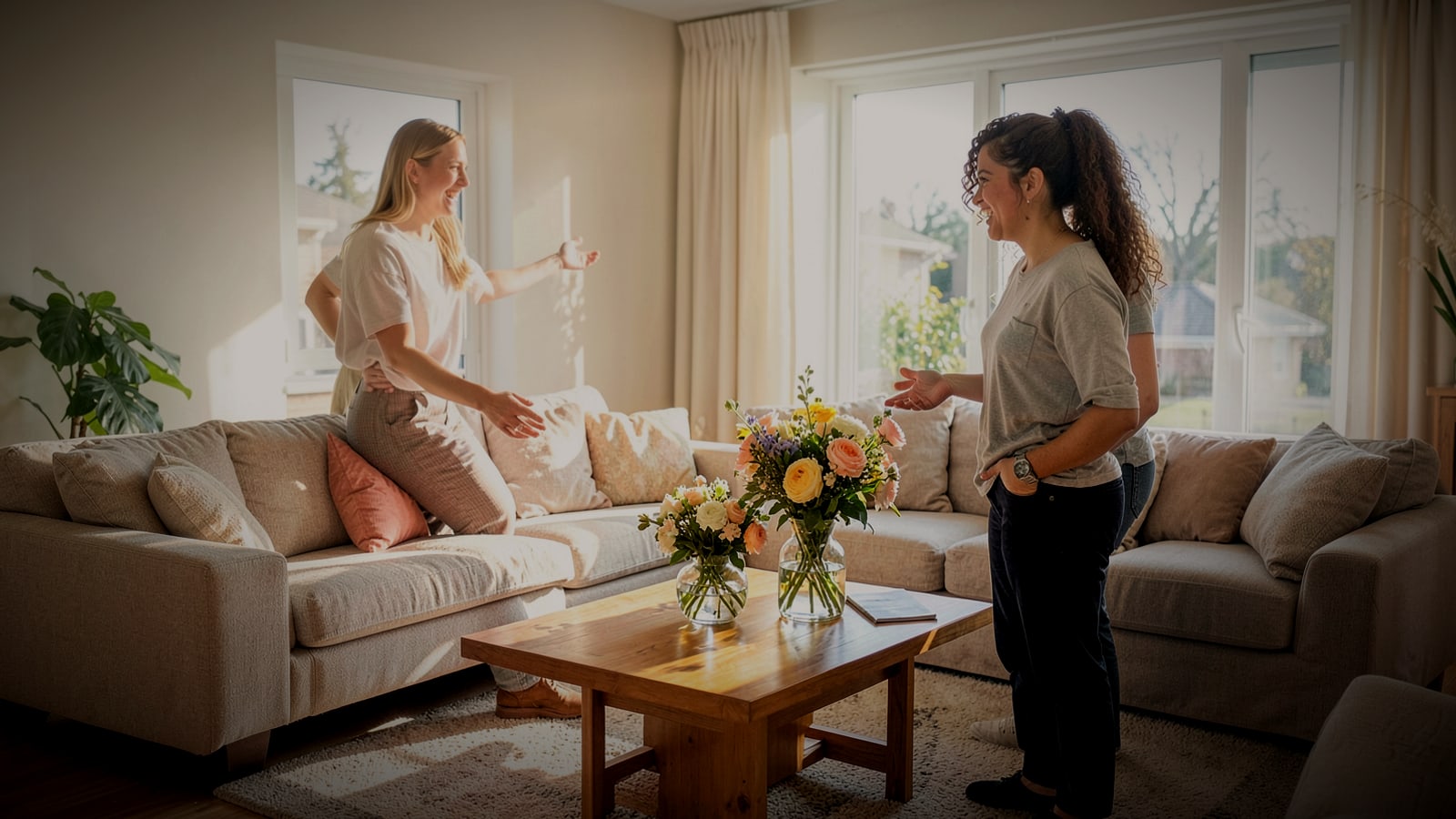
Soft music can make an empty listing feel lived-in and give buyers room to talk. It can also feel like a sales trick or hide what buyers need to hear. Here is how to set up open house music room by room, what the research on congruent atmosphere suggests, and what agents should know about licensing.
Walk into a vacant house in silence and you hear everything: your own footsteps, the refrigerator hum, the other couple whispering in the next room. Many buyers feel like guests who should not speak. A little open house music changes that. It makes an empty or staged home feel lived-in and gives visitors the acoustic privacy to say what they really think. Done badly, it feels like a sales trick, fights with the agent's conversations, or hides the very things buyers came to check.
This guide is for listing agents, stagers and sellers. It covers where music helps, how to set it up room by room, what research on atmosphere suggests, and the licensing question most agents never consider.
What open house music is for
Music at a showing has three honest jobs.
- Comfort. Silence in a stranger's home is awkward. Soft background music gives people permission to relax, linger and talk.
- Privacy. Couples discussing price, repairs or a deal-breaker want to do it without the agent overhearing. A low background level makes that easier.
- Atmosphere. Staging is about helping buyers picture living in the home. Music is part of that picture, along with light, temperature and scent.
It is not there to sell the house on its own, and it should never be used to hide something.
Music for real estate showings, room by room
Treat the house as a set of zones, just as a restaurant or hotel would.
- Entry and main living area: the main source. Low, warm, mostly instrumental music at a level that sits below a normal conversation.
- Kitchen: often where people gather and talk longest. The same music at the same or slightly lower level.
- Bedrooms and bathrooms: usually no music. Buyers want to hear how quiet these rooms are.
- Home office: off. Buyers who work from home will want to judge the room as a workspace.
- Outdoor areas: only if you can keep it low and it will not bother neighbors. A patio with a gentle playlist can help sell outdoor living; a speaker blasting across the yard does the opposite.
One small speaker in the main living area is usually enough for a typical home. For larger homes, two modest speakers at low volume sound better than one loud one trying to reach every room.
Choosing an open house playlist
The same principles that work for boutiques and hotel lobbies work here.
- Mostly instrumental. Lyrics pull attention and invite opinions. You want buyers thinking about the house, not the song.
- Warm and mid-tempo. Calm, jazzy or acoustic grooves suit most homes. Avoid anything aggressive, sad or overly sleepy.
- Neutral, not personal. Your favorite band or the seller's taste is irrelevant. The goal is a sound that almost nobody minds.
- No holiday or novelty tracks unless the whole home is seasonally staged, and even then keep it subtle.
- Long enough. A three-hour open house should not loop a 45-minute list. Visitors who come early and return later will notice.
Jazzy chillhop and soft piano are a reliable default. Our chill collection, for example, is built from soft piano loops, muted jazz guitar and brushed drums at relaxed tempos, the kind of sound that fits a staged living room without drawing attention.
Match the music to the staging
Home staging music works best when it agrees with everything else in the room. There is research behind that idea. In a 2005 experiment in a mock retail store, published in the Journal of Business Research, Spangenberg, Grohmann and Sprott combined Christmas or non-Christmas music with either a Christmas scent or no scent (Spangenberg et al., 2005). With 130 participants, evaluations of the store and its merchandise were more favorable when the Christmas scent was paired with Christmas music. The same scent with non-Christmas music lowered evaluations.
That was a store, not a house, and a single lab-style study. But the lesson transfers easily: mismatched cues can backfire. If the home is staged as a calm modern space with neutral colors and a light scent, a loud party playlist fights it. If the home is a rustic farmhouse, sleek electronic music feels wrong. Walk through the staged home once in silence, decide what feeling it gives you, and choose music that says the same thing. Our overview of how music affects sales covers other studies on fit and atmosphere, along with their limits.
Background music for open house volume and setup
The right level is lower than most people expect. Background music for an open house should be something visitors notice only if it stops. Our guide on how loud background music should be explains how to set levels in any space; for a home, the practical test is simple.
- Arrive early and set up before the first visitor.
- Stand in the middle of the main room and talk at a normal voice with a colleague. If either of you raises your voice, it is too loud.
- Walk to the bedrooms. You should barely hear it, if at all.
- Check that playback will not stop: use a playlist with no ads, disable notifications on the playing device, and keep it charged.
- Keep your own phone off the speaker so calls and messages do not interrupt the music or broadcast to the room.
- Turn it down when you are speaking with a group, and turn it off immediately if a buyer asks.
When not to use music
- Never to mask noise. If the home backs onto a highway, a rail line or a noisy neighbor, buyers deserve to hear it. Hiding it only moves the disappointment to the second showing or the inspection, and it damages trust in you.
- Private showings with serious buyers. Many prefer silence so they can concentrate. Ask.
- Homes that sell quiet. A rural or wooded property may be sold on birdsong and stillness. Let it speak.
- When the seller objects. It is their home and their equipment.
Can realtors play music at an open house?
This is the question almost nobody asks. This section is general information, not legal advice.
U.S. copyright law gives songwriters and publishers the right to control public performances. Under 17 U.S.C. 101, a performance is public if it takes place at a place open to the public or where a substantial number of people outside a normal circle of family and social acquaintances is gathered. An advertised open house is, by design, open to the public, so music played there is plausibly a public performance, even though it happens in a private home.
In practice, most agents use a personal streaming app on their phone. Personal accounts are licensed for personal, non-commercial listening, which is why we explain in can I play Spotify in my store that they are not the right tool for business use. A brokerage that wants to do things properly has three honest options:
- No music, which is always legal and sometimes the best choice anyway.
- Music licensed for business public performance in that setting. Ask your provider directly whether its license covers temporary locations such as listings.
- Keep licensed music for your permanent spaces, such as the brokerage office and reception.
WeavyAudio is built for the third case. Our license covers background playback at a subscriber's registered location, as set out in section 3 of our terms, so it fits a brokerage office or another permanent space you register with us. A rotating set of listings is not a registered location, so do not assume coverage there without asking us first. If you want licensed, calm music for your office, you can see the plans.
FAQ
What is the best open house music?
Warm, mid-tempo, mostly instrumental music such as soft piano, light jazz or chillhop, played at a level below normal conversation in the main living areas and off in bedrooms and offices.
Should you play music during a house showing?
Often, yes, for open houses with several groups, because it removes awkward silence and gives buyers privacy to talk. For private showings, ask the buyers; some prefer silence.
How loud should music be at an open house?
Quiet enough that two people can talk at a normal voice in the same room without effort, and barely audible in bedrooms. If you notice it while talking, it is too loud.
Can realtors play Spotify at an open house?
Personal streaming accounts are licensed for personal use, and an advertised open house is open to the public. Use music licensed for business use, or none. This is general information, not legal advice.
Should music match the home staging?
Yes. Research on retail atmosphere found that mismatched cues, such as a seasonal scent with unrelated music, lowered evaluations. Choose music that fits the style and mood of the staged home.