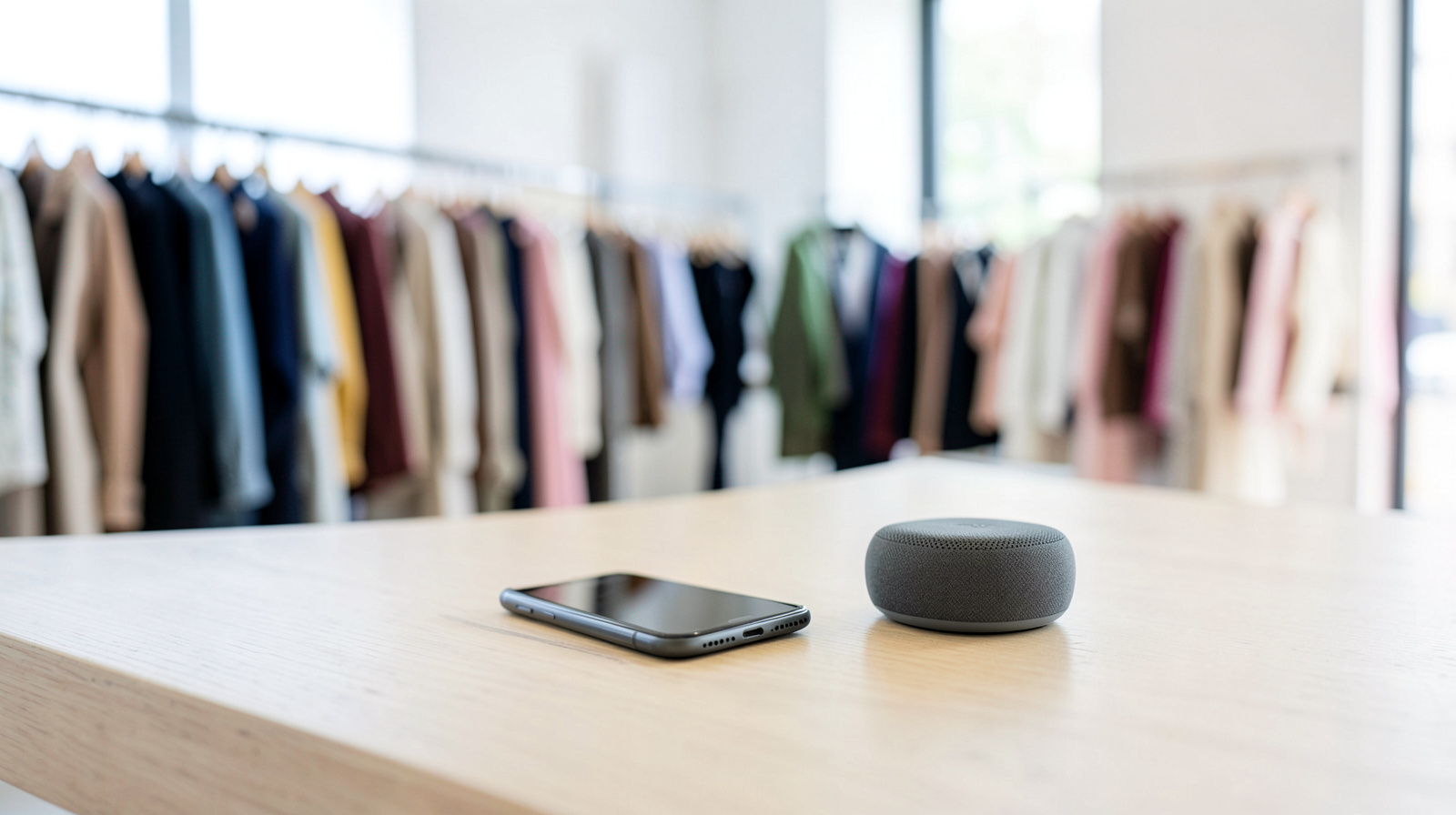
A phone, a Spotify account and a Bluetooth speaker is a very common setup in small businesses. It also breaks the terms of Spotify, Apple Music, YouTube and Pandora. Here is what they say, and what to use instead.
It is one of the most familiar music setups in small businesses: a phone or laptop, a Spotify or Apple Music account, and a speaker. It sounds good, it costs little, and your playlists are already there. Unfortunately, it is not allowed, and the reasons are worth understanding, because they also point to what you should use instead.
This article is general information, not legal advice.
What Spotify's own terms say
Spotify's Terms of Use grant users permission to make personal, non-commercial use of the service and its content. Its help center goes further. The Spotify support article on public or commercial use says you cannot broadcast or play Spotify publicly from a business, and it lists examples: bars, restaurants, schools, stores, salons, dance studios and radio stations. For commercial settings, Spotify points businesses to a separate partner service instead of a personal account.
Premium does not change this. Paying removes ads and unlocks features for you as a listener. It does not turn a personal subscription into a business license.
Apple Music, YouTube, Pandora and the rest
The other big consumer services work the same way:
- Apple Music. Apple's Media Services Terms say the services and content may be used only for personal, noncommercial purposes, and that Apple's delivery of content does not transfer any commercial or promotional use rights to you.
- YouTube. The YouTube Terms of Service allow viewing and listening for personal, non-commercial use, and give an example of what is not allowed: publicly screening videos or streaming music from the service.
- Pandora. Pandora's consumer terms limit use to your own individual, personal, non-commercial purposes.
If you are using any other consumer app, look for the words "personal" and "non-commercial" in its terms. They almost always appear.
Problem one: you are breaking the service's terms
The first issue is contractual. Using a personal account in a business violates the agreement you accepted when you signed up. The practical risk is that the provider can restrict or close the account, taking every playlist you have built over the years with it.
Problem two: you still have no public performance license
The second issue is copyright. Playing music where customers can hear it is a public performance, and the songwriters and publishers behind those songs are usually represented by performing rights organizations such as ASCAP, BMI, SESAC and GMR. A consumer subscription gives you access to recordings for personal listening. It does not give you permission to perform them publicly.
BMI says this directly in its restaurant FAQ: a digital music subscription gives you access to a huge collection of music, but it does not provide the permissions needed to play that music in a business.
If an unlicensed performance ends up in court, copyright law allows statutory damages of $750 to $30,000 per song, and up to $150,000 per song if the infringement is found to be willful.
What about CDs and music you bought?
Owning a copy is not the same as owning the right to perform it. When you buy a CD or a download, you get a copy to listen to; the songwriters keep their public performance right. BMI's fitness FAQ says purchased audio files do not include U.S. performing rights, and Apple's terms say its delivery of content does not transfer commercial use rights. A shelf of CDs or a folder of purchased tracks therefore still needs PRO coverage for the songs on it before it plays in a store. The same caution applies to "no copyright" compilations on video sites: even if a track is free to use in some contexts, streaming it publicly from a consumer platform still conflicts with that platform's personal-use terms.
"I bought a PRO license. Can I use Spotify now?"
Not with a personal account. A PRO license solves the copyright side for that organization's songs, but it does not change the streaming service's terms, which still prohibit commercial use. You need both: the rights to perform the music and a source whose terms allow playback in a business.
"What about the small-business radio exemption?"
Section 110(5)(B) of the Copyright Act lets qualifying small businesses play radio and TV broadcasts without a license, within size and equipment limits. It applies to broadcasts from FCC-licensed stations (and, for TV, cable or satellite), not to streaming apps, downloads or your own playlists.
A 60-second check of your current setup
- Does all the music in customer areas come from a source licensed for business use, rather than a personal app account?
- Do you have something in writing that covers public performance at this address?
- Does that coverage include every source you use, including TVs and events?
- Could you show that paperwork within five minutes if someone asked?
If any answer is no, the fix is usually simpler than it looks.
Legitimate ways to get the same vibe
- A business music service with licensing included. These are built for venues. BMI notes that such services typically include a BMI license only for the music they provide, so other sources in your venue still need their own licensing.
- PRO licenses plus a source that allows business use. Workable, but you are managing several agreements and still need a player whose terms permit commercial playback.
- An original catalog that does not involve PROs. WeavyAudio's catalog is original and owned by WeavyAudio, so there are no PRO royalties for that music, and your subscription includes a license to play it publicly at your registered location.
How to switch without losing what your regulars like
The fear with switching is losing the sound you have built. You can avoid that with a methodical move instead of a leap.
- List your three to five most-played playlists. Note when each one plays and what job it does: waking the room up, keeping the lunch line moving, winding down the evening.
- Describe each playlist in plain terms. Tempo (slow, medium, fast), vocals or instrumental, energy level, and two or three genre words. "Mellow indie with soft vocals" is more useful than an artist list.
- Translate each description into genres and moods. A mellow indie morning maps well to our indie collection. A focused, beat-driven afternoon maps to lo-fi. Our playlists page is a quick way to hear ready-made mixes by mood and genre.
- Test through a full shift. A playlist that sounds great for ten minutes can wear thin by hour six. Ask staff what they would skip.
- Fill the gaps. If a specific feel is missing, you can request a custom track, which is free during our launch period.
- Set a house rule. No personal phones on the house speakers. One licensed source, clearly documented, is the easiest setup to defend.
Every active WeavyAudio subscription also mints a signed PDF license certificate for your location, which is handy if anyone ever asks where your music comes from. If that sounds like the simpler path, you can try WeavyAudio free and compare it with your current setup during the trial.
FAQ
Is it illegal to play Spotify in a restaurant?
Playing a personal Spotify account in a restaurant breaks Spotify's terms, and without public performance licenses it can also infringe the songwriters' copyrights. Either issue is reason enough to switch to a source built for businesses.
Does Spotify offer a business version?
Not as an upgrade to a personal account. Spotify's support page refers businesses to a separate partner service built for commercial use.
Can my staff listen to Spotify at work?
An employee listening on their own headphones is personal listening. Music played through speakers in customer areas is a public performance and needs a source licensed for business use.
Can I play YouTube playlists on the TV in my shop?
No. YouTube's terms limit the service to personal, non-commercial use and specifically mention that you may not publicly screen videos or stream music from it.
Can I get in trouble for playing Spotify in my store?
Yes. The provider can close the account, and PROs pursue businesses that perform their members' music without a license. If a case reaches court, statutory damages are counted per song.