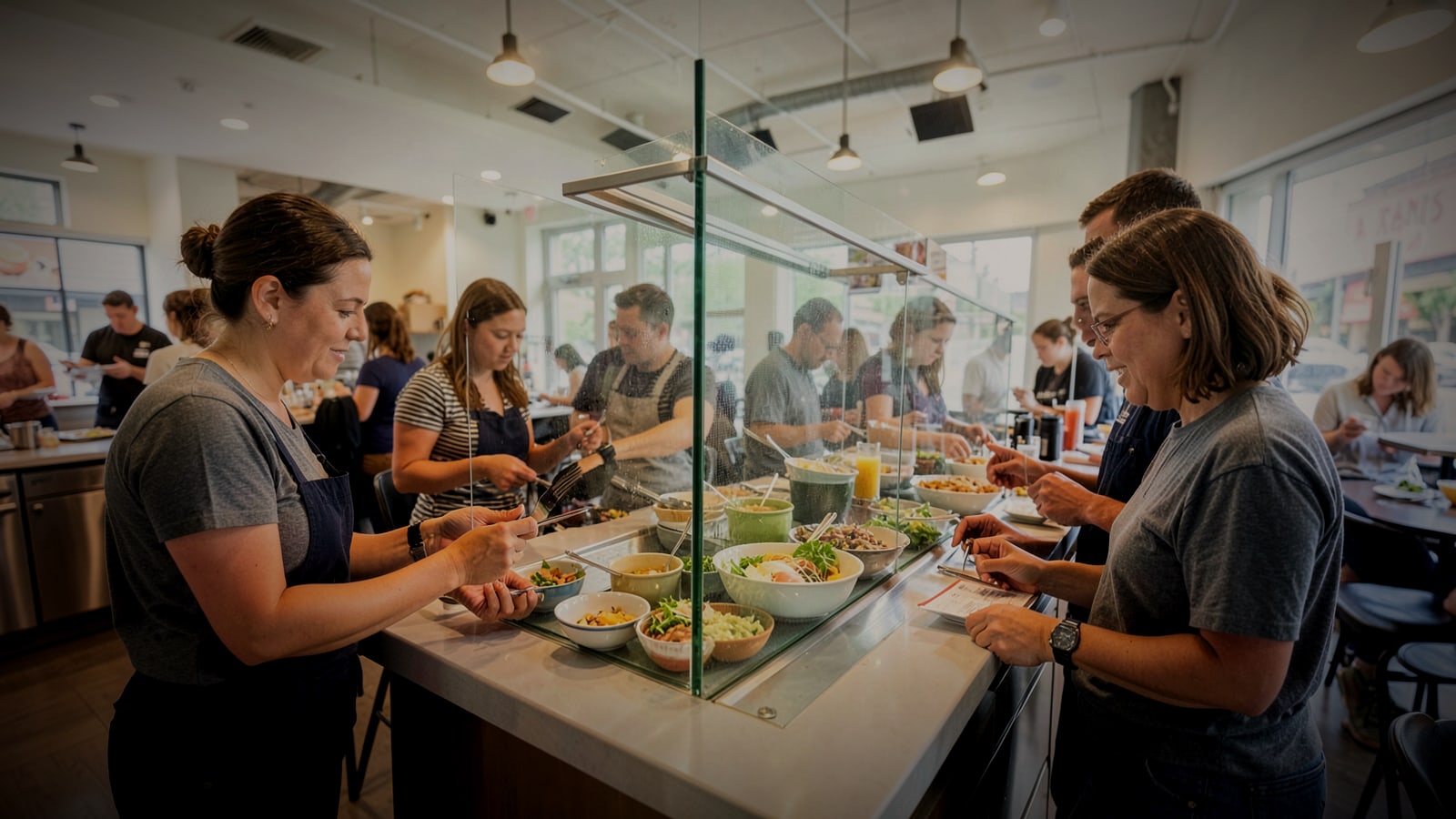
In a fast casual restaurant, music has to keep the line moving, make a busy room feel good and still let staff hear orders. Here is a practical playbook for fast casual restaurant music: tempo and energy by daypart, volume around the counter, pickup and patio areas, staff buy-in and licensing.
Fast casual restaurant music works under different rules from fine dining. Guests order at a counter, the line matters more than the linger, and many tables turn in under half an hour. The music has to keep a busy room feeling energetic, make the wait in line feel shorter and still let the team hear "no onions, extra sauce" on the first try.
This playbook covers quick service restaurant music and music for counter service restaurants of all kinds, from bowl and burrito concepts to burger, sandwich and pizza shops: which tempo to choose for each part of the day, how loud to play it, how to handle pickup and patio areas, and how licensing works.
What music does in a counter-service restaurant
In a full-service restaurant, music mostly shapes the mood of a long meal. In a fast casual restaurant, it has four more practical jobs:
- Energy. A room full of hard surfaces and quick meals feels flat without a steady beat underneath it.
- Queue comfort. People in line have nothing to do but wait. Pleasant music fills that time.
- Masking. Kitchen noise, the ticket printer, the drinks machine and staff calls are part of the concept, but not all of them need to be heard across the room.
- Pace. Music can nudge how long people stay, which matters when seats are limited at lunch.
What research says about tempo and time at the table
The best-known field study on restaurant music tempo was run by Ronald Milliman in a restaurant. With slow music, dining parties stayed longer at their tables, an average of 56 minutes compared with 45 minutes with fast music, and they spent more at the bar, while food spending did not change significantly (Milliman, 1986, Journal of Consumer Research).
That was a single full-service restaurant in the 1980s, so treat it as evidence that tempo can shift behavior, not as a formula. For restaurant table turnover music, the practical lesson for fast casual is straightforward: at peak times, when you need seats, avoid very slow, sleepy music. In quiet hours, when you would like people to stay and order a second drink or dessert, you can slow it down.
Choosing restaurant music tempo by daypart
As a working guide, slow music sits under about 90 beats per minute, mid-tempo around 90 to 115 and upbeat above that. Most fast casual concepts live in the mid-tempo to upbeat range for most of the day. Our music dayparting guide explains how to split the day into blocks.
Opening and morning
If you serve breakfast or coffee, start bright and mid-tempo. Guests are on their way somewhere, and music should feel fresh without being loud.
Lunch rush
Your most important block. Choose upbeat, familiar-feeling music with a steady rhythm: pop, funk, soul, light house and Latin grooves. Keep the energy consistent rather than jumping between very fast and very slow tracks. Our upbeat mood collects bright pop and house tracks suited to this kind of block.
Afternoon lull
Bring the energy down a notch. Few guests, often students, remote workers or late lunches. Mid-tempo and relaxed is fine, and you can let people linger.
Dinner and evening
Fast casual dinner guests are more often groups, families and couples than solo lunch customers. Keep it upbeat but warmer, and raise the volume slightly as the room fills.
Late night
If you stay open late, especially in music for pizza restaurants near bars or campuses, a later block can take more energy. Keep an eye on lyrics if families are still around.
Volume around the counter
Order accuracy is the first priority. If staff cannot hear customers, orders go wrong and lines slow down, which undoes everything the music is meant to do.
- Test at the register. A customer should be able to order at a normal speaking level, and the cashier should hear every modification the first time.
- Keep speakers away from the order point. Point them at the dining area and the line, not the register or the expo station.
- Raise the level gradually as the room fills, then lower it again after the rush. Full rooms absorb sound, but they also make more noise.
- Do not fight the kitchen. If the room is loud because of equipment and hard surfaces, turning the music up just makes everything louder. Acoustic panels help more.
Pickup shelves, drive-thru and patios
- Pickup areas. Delivery drivers and pickup customers want to find their order and go. Music here should match the main room at a lower level.
- Drive-thru lanes. Music should not leak into the order microphone. Keep speakers well away from the ordering point and headsets.
- Patios. Outdoor speakers are subject to local noise rules and neighbors. Keep them lower than you think and turn them down in the evening.
Getting the team on board
Staff hear your music for entire shifts. Short playlists on repeat are one of the main reasons teams switch to their own phones.
- Use long rotations. A block that runs three hours should draw from many more than three hours of music.
- Give the shift lead control of the volume, within agreed limits.
- Have a before-opening block for prep and cleaning, then switch to the guest schedule before the doors open.
- Ban personal accounts on the restaurant system. It keeps the sound on brand and avoids a licensing gap.
Licensing music in a fast casual restaurant
Under U.S. copyright law, the owner of a musical work has the exclusive right to perform it publicly (17 U.S.C. 106). A restaurant open to customers is a public place, so background music there generally needs a public performance license. Consumer streaming apps are licensed for personal use and do not cover it.
Restaurants usually choose between licenses from the performing rights organizations that represent the songs they play, alongside a music source that allows business use, or a business music service that includes the performance license for its own catalog. Our guide to background music for restaurants covers the options for food businesses in more detail.
WeavyAudio is the second kind: an original catalog owned by WeavyAudio, with a license to publicly perform it at your registered location, as set out in section 3 of our terms. Pricing is one flat fee per location. It does not cover TVs, live music, other music sources or using the tracks in social videos or ads.
Fast casual restaurant music checklist
- Split the day into blocks: opening, lunch rush, afternoon lull, dinner and late night.
- Keep peak blocks upbeat and steady; slow things down only when you have spare seats.
- Test volume at the register during the rush.
- Keep speakers away from order points, drive-thru microphones and neighbors.
- Use long rotations so staff are not hearing the same songs every shift.
- Move music off personal phones and onto a source licensed for business use.
For more on matching music to restaurant formats, see our page on music for restaurants. When you want one licensed catalog across your dining room, you can see the plans.
FAQ
What music is best for a fast casual restaurant?
Upbeat, familiar-feeling music with a steady rhythm works for most fast casual concepts at peak times: pop, funk, soul, light house and Latin grooves. Bring it down to a relaxed mid-tempo in quiet afternoon hours.
Does fast music make customers eat faster?
A classic restaurant study found that slow music was linked with longer stays at the table than fast music. It was a single restaurant decades ago, so treat tempo as one lever for pace, not a guaranteed way to turn tables.
How loud should music be in a quick service restaurant?
Loud enough to give the room energy, but quiet enough that guests can order at a normal speaking level and staff hear every modification. Test at the register during the rush.
Can a fast casual restaurant play Spotify?
Consumer streaming subscriptions are generally licensed for personal use only, so playing them in a restaurant is usually outside their terms. Use a business music service or the appropriate licenses. This is general information, not legal advice.