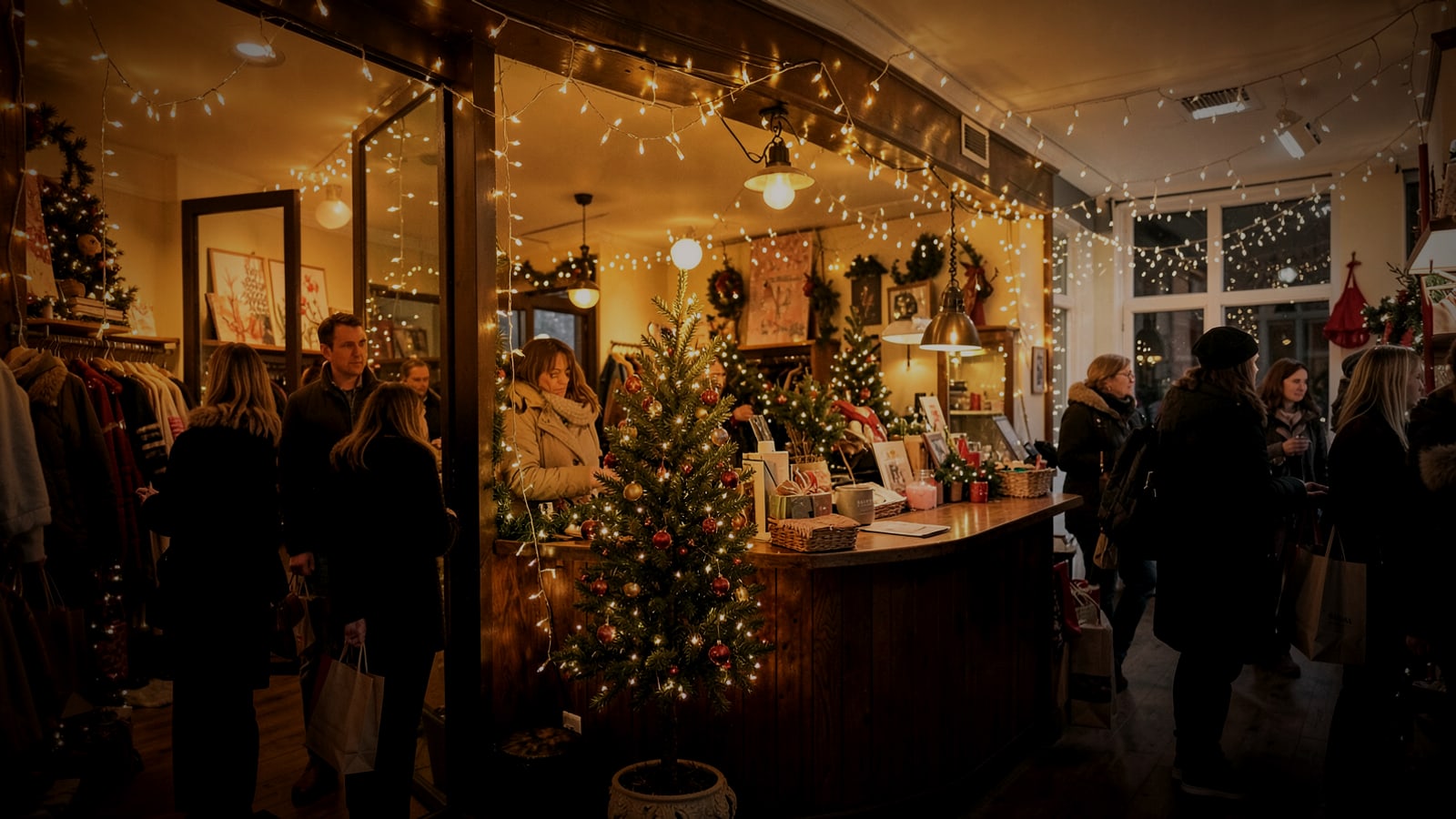
Many owners assume Christmas songs are old enough to be free. Some compositions are, but the arrangement and recording you actually play usually are not. Here is how the three layers of rights work, what entered the public domain in 2026, when to start holiday music and how to keep your team sane.
Every autumn the same three questions arrive in business owners' inboxes and staff chats: when do we start the holiday music, which songs do we play, and are we allowed to? The third question gets the least attention, partly because of a common assumption: Christmas songs are old, so surely they are free to use.
Some of them are. But the version you actually play in your shop or restaurant usually involves rights that are much newer than the carol itself. This guide to Christmas music for business explains how those rights stack up, what is really in the public domain in 2026, how to plan the season from November to New Year, and how to avoid wearing out your team.
This article is general information, not legal advice. If you are unsure about your setup, talk to a copyright attorney.
Three layers of rights in every Christmas track
Any recording of a Christmas song can involve three separate layers, each with its own owner and its own copyright clock.
- The composition. The melody and lyrics, owned by songwriters and publishers. For public playback in a business, composition rights are what performing rights organizations license.
- The arrangement. A new arrangement of an old carol can be protected in its own right. Under 17 U.S.C. 103, the copyright in a derivative work covers only the new material its author contributed, not the older work underneath, but that new material can still be protected.
- The recording. The specific performance captured on a recording has its own copyright, separate from the song.
A carol can be free at the first layer and still protected at the second and third. That is the whole trap.
What is actually in the public domain in 2026
Under current U.S. law, published works generally enter the public domain 95 years after publication. As Duke's Center for the Study of the Public Domain explains in its Public Domain Day 2026 overview, works from 1930 entered the public domain on January 1, 2026, and so did sound recordings from 1925, under the 100-year rule set by the Music Modernization Act.
For holiday music, that means:
- Traditional carols are generally public domain as compositions. Songs such as "Silent Night", "Jingle Bells", "Deck the Halls", "Joy to the World" and "O Holy Night" date from the 19th century or earlier.
- Most mid-century standards are still protected. "Winter Wonderland" was published in 1934, so under the 95-year rule it stays protected until 2030. "White Christmas" (1942), "Rudolph the Red-Nosed Reindeer" (1949) and "Jingle Bell Rock" (1957) are further away still, and modern hits even more so.
- Almost every recording you would want to play is protected. Only recordings from 1925 or earlier are public domain in 2026, and those are rarely what a shop wants on its speakers.
The practical upshot is simple. A public-domain carol, performed in a modern arrangement, on a modern recording, is almost always protected at one layer or another. "It's a public domain song" rarely helps a venue that just wants to press play.
What about "royalty-free Christmas music"?
Searches for royalty-free Christmas music for commercial use spike every December, usually from people making videos. Royalty-free licenses sold for video projects do not always include public performance in a venue, and some tracks sold as royalty-free are still registered with a PRO. Read the license for the words "public performance" and your type of business before you use a track in a shop.
Your legal options
- Hold the PRO licenses and use a source licensed for business playback. This covers the famous songs, provided the source itself is licensed for use in a business.
- Use a business music service that includes the relevant rights. Ask exactly which rights are included.
- Use an original catalog licensed for venue play. No PRO repertory is involved, but you will not hear the famous standards.
- Do not rely on a personal streaming account. We explain why in Can I Play Spotify in My Store?
- Check the radio exemption carefully. It exists, but with limits on size, speakers and setup, covered in Do I Need a License to Play Music in My Business?
When should you start playing Christmas music?
There is no official date. Many large retailers start in early November, most restaurants later, and Thanksgiving weekend is a common switch point for everyone. In 2026, Thanksgiving falls on November 26 and Christmas Day on a Friday. A gradual ramp works better than a sudden switch:
- November 1 to Thanksgiving: winter-warm music with festive hints; holiday tracks at most one in five, mostly instrumental and mostly in the evening.
- Thanksgiving weekend to mid-December: raise the share to between a quarter and half of the rotation in customer areas.
- December 15 to 24: the peak. Holiday music can lead during busy hours, with calmer, non-holiday music in quiet periods.
- December 26 to 31: move from Christmas to winter and celebration music as the room turns toward New Year's Eve.
- January 2: reset to your normal rotation.
These proportions are starting points, not findings from research. For retail-specific tips on tempo and zones, see our guide to background music for retail stores.
Make the whole environment agree
One study is often cited on holiday atmosphere, and it has a useful lesson. In a laboratory experiment published in the Journal of Business Research in 2005, Eric Spangenberg, Bianca Grohmann and David Sprott showed 130 participants images of a department store while varying the scent and the music in the room (study). Evaluations were more favorable when a Christmas scent was paired with Christmas music, and the Christmas scent with non-Christmas music lowered evaluations.
It was a single lab study with students, not a field test in a real store, so treat it as a hint rather than a rule. The hint is still worth taking: festive decorations and scents paired with music that ignores the season can feel off. Decide how festive you want to be, then make music, decor and scent agree.
Protect your staff from carol fatigue
Customers hear your holiday playlist for twenty minutes. Your team hears it for weeks.
- Rotate widely. Avoid the same twenty standards on a loop; variety matters more than any single song.
- Use instrumental and winter-themed tracks between festive ones. They keep the season present without constant lyrics.
- Keep back-of-house separate. Break rooms and kitchens do not need the customer playlist.
- Ask your team. A quick poll before Thanksgiving tells you where the limit is.
- Watch the volume. Busy December rooms get louder; the music should not chase the crowd.
Make room for everyone
Not every guest celebrates Christmas. Mixing winter-themed and secular seasonal music with a smaller share of religious carols keeps the room festive without making anyone feel like an outsider. For many venues, cozy winter music does most of the work.
Where WeavyAudio fits
Our catalog is built for year-round background music rather than for Christmas standards, and we will not pretend otherwise. Where it helps in December is in the hours between festive moments: warm, calm tracks that keep a busy season from becoming exhausting. The lo-fi and chill tracks in our chill collection suit quiet December mornings. If you want an original festive track for your venue, you can request a custom track, currently free during launch.
To hear how an original, venue-licensed catalog fits around your holiday plan, you can start a WeavyAudio free trial before November.
FAQ
Are Christmas songs public domain?
Some compositions are, including many traditional carols. Songs published in 1930 or earlier are in the U.S. public domain in 2026, but most famous standards are newer, and modern arrangements and recordings have their own protection.
Can I play Christmas music in my store without a license?
Usually not. Playing music customers can hear is a public performance, and nearly every recording you would use is protected at some layer. Use licensed sources or original music licensed for venue play.
Is royalty-free Christmas music OK for my business?
Only if the license explicitly covers public performance in a business like yours. Many royalty-free licenses are written for videos, and some tracks are still registered with a PRO.
When do stores start playing Christmas music?
There is no set date. Many large retailers start in early November, while restaurants and smaller shops often wait until Thanksgiving weekend. A gradual ramp keeps both customers and staff happier.
Do I need a license for a public domain carol?
Not for the composition itself, but you still need the right to use the arrangement and recording you play. Unless both are also public domain or licensed to you, the carol alone does not make playback free.
Christmas Music for Business: What Else to Know
When selecting Christmas music for your business, it's essential to consider the rights involved. Most commercial recordings of popular Christmas songs are copyrighted and require a license to play publicly. This includes tracks by modern artists covering classic carols, as well as original compositions that evoke a festive atmosphere. To avoid potential copyright infringement, choose licensed or public domain options specifically cleared for business use.
What is the typical timeline for playing Christmas music in stores?
Stores typically start playing Christmas music in late November and continue through New Year's Day, with some businesses starting as early as mid-October to create a festive atmosphere before Black Friday sales. Plan ahead by selecting licensed tracks that can be played continuously throughout the holiday season.
How do I ensure my staff doesn't get tired of hearing the same Christmas songs repeatedly?
Mix up your playlist with a variety of genres, tempos, and styles to keep the atmosphere fresh. Consider incorporating non-traditional Christmas music, such as jazz or Latin-inspired tracks, to appeal to different tastes and prevent carol fatigue among staff and customers alike.