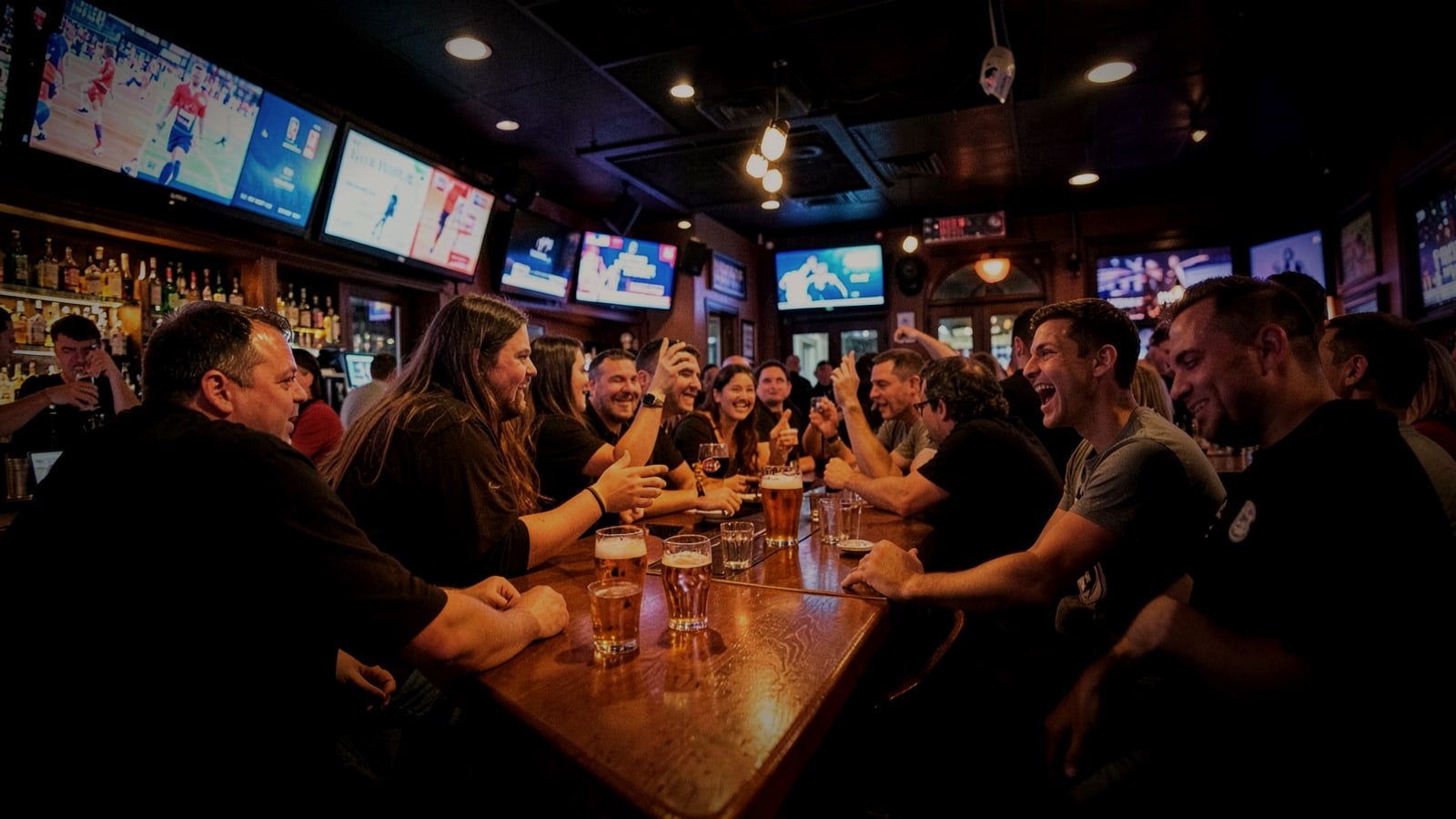
In a sports bar the soundtrack changes with the schedule. Here is a playbook for sports bar music: which game gets the sound, what to play before kickoff, at halftime and after the final whistle, how to fill the off-hours, and the licensing rules for TV broadcasts and sports packages.
A sports bar has two soundtracks: the game and everything else. On a big game day the room wants commentary, crowd noise and a shared roar when the home team scores. On a quiet Tuesday afternoon with five screens showing highlights on mute, the same room feels empty without music. Most of the problems with sports bar music come from not deciding in advance which soundtrack is in charge, and when.
This playbook on music for sports bars covers how to run game days and off-hours, how to handle TV audio vs music, what to do at halftime and after the final whistle, and the licensing rules that apply to TVs, sports packages and music.
The core rule of sports bar music: one sound source per area
Never run game audio and music at full level in the same area. The result is noise: commentary fighting a chorus, staff shouting orders, customers giving up on conversation. Pick one per area, per moment.
- Game audio on: music off in that area, or at a very low level between plays in a separate zone.
- Game audio off (screens on mute with captions): music on as the main sound.
- Split rooms: if you have a bar area and a dining room, one can carry the game while the other carries music, as long as the sound does not bleed across.
Write this down as a simple policy. When the bartender on a Saturday shift knows exactly when to switch, you avoid the "who turned the game off" argument entirely.
Game day: a minute-by-minute playbook
Two hours to kickoff
This is when the room fills. Game day music should build energy: upbeat, familiar-sounding, with a steady beat and a lift in tempo as kickoff gets closer. Our energetic mood collection is built for this: driving drums, bright synths and tempos mostly between about 112 and 138 BPM. For a country-leaning crowd, lean into Americana and country rock.
Pregame show
When the pregame coverage starts to matter to your crowd, fade the music and bring up the TV audio on the main screens. Do not cut abruptly; a thirty-second fade feels intentional.
During the game
Game audio has priority on the main screens. Keep music off in that area. If you have a patio or a back room without screens, it can carry low music.
Halftime
Halftime is the most common switching decision. Two good options:
- Switch to music. Bring music up for the break, especially if the broadcast is analysis your crowd does not care about. Fade back to the game a minute before the second half.
- Stay on the broadcast. For a championship game or a halftime show people came to see, keep the TV sound.
Whatever you choose, make it the same every time so regulars know what to expect.
Final whistle
Give the room a few minutes of post-game coverage, then bring music back. After a win, lift the energy. After a loss, something warm and mid-tempo helps keep people in their seats for another round instead of heading straight for the door.
Multiple games at once
On a busy Sunday or during a tournament, several games may matter to different tables. Choose one "sound game," usually the one with the most local interest, and put the others on captions. Tell customers which game has the sound, and let them know the schedule if it will change.
Off-hours: most of the week
Most sports bars spend more hours outside of big games than during them. That is where a planned sports bar playlist earns its keep.
- Lunch: mid-tempo, friendly, lower volume. Highlights on mute, music on.
- After work: a lift in energy, familiar-sounding music that suits your crowd, whether that is country, rock, hip-hop or pop.
- Late night without games: your bar's signature sound, a little louder, still below the level where people have to shout.
- Trivia and events: music low or off while the host speaks.
Your bars hub collects music that suits evening venues and can be your base for off-hours. Whatever you choose, keep explicit lyrics out of family hours and daytime service.
Volume and sound: getting TV audio in bars right
- Separate the systems if you can. A mixer or zoned system that lets you route TV audio and music to different speakers is the single most useful upgrade for a sports bar.
- Keep commentary intelligible. Crowd noise plus a big-screen broadcast is loud. Commentary should be clear at the bar without being deafening in the booths.
- Set levels for a full room and for a quiet room. Write both down. Our guide to how loud background music should be explains how to measure and set them.
- Give one person control on each shift. Remote controls and apps should not be passed around the bar.
Licensing: TVs, sports packages and music
This section is general information, not legal advice. Sports bars sit at the crossroads of several licensing rules, and bar TV licensing is the part owners most often get wrong, so it helps to keep the rules separate.
Broadcast TV and radio in the bar
Broadcasts contain copyrighted music: theme songs, stadium tracks, ads and halftime shows. Showing a broadcast in public is a public performance of that content. The business exemption in 17 U.S.C. 110(5) allows food service and drinking establishments to show licensed broadcasts without a separate license only in limited cases. A bar under 3,750 gross square feet qualifies. A larger bar qualifies only if, for audiovisual devices, it has no more than four TVs, no more than one per room, none larger than 55 inches diagonal, and no more than six loudspeakers in total with no more than four in any one room. It also must not charge a direct fee to watch or hear the broadcast. Many sports bars have more screens than that, which is why most of them hold licenses from the performing rights organizations. Our guide to ASCAP and BMI fees for restaurants and bars explains how those are priced.
Sports packages and pay-per-view
Subscription sports packages and pay-per-view events are sold on separate commercial terms for businesses, usually priced by venue size or occupancy. Showing a residential subscription in a bar is a common and expensive mistake. Federal law on unauthorized interception of communications, 47 U.S.C. 605, allows statutory damages of $1,000 to $10,000 per violation, and a court can add up to $100,000 per violation when it is willful and for commercial advantage. Cable service has a parallel provision. Always buy the commercial version of any package or event you show.
Background music
Music you play between games is a separate question. Personal streaming accounts are licensed for personal use, not for a bar. You can hold performing rights organization licenses that cover the songs you play, or use a business music service that licenses its own catalog. WeavyAudio's catalog is original, and a subscription includes a license to publicly perform it at your registered location, as described in section 3 of our terms. It covers our music only. TV broadcasts, sports packages and live bands each need their own licensing.
Sports bar music checklist
- Write a one-page policy: which area gets game audio, and when music plays.
- Decide your halftime and post-game routine and train every shift on it.
- Pick a "sound game" rule for busy days with several games on.
- Route TV audio and music to separate zones if your system allows.
- Build an off-hours schedule for lunch, after work and late night.
- Keep explicit lyrics out of daytime and family hours.
- Count your screens and speakers and check them against the broadcast exemption.
- Make sure every sports package and pay-per-view event is on a commercial account.
- Confirm your background music source is licensed for business use.
If you want one cleared source for the hours between games, you can see the plans.
FAQ
Should a sports bar play music or game audio?
Both, but never at full level in the same area. Give the main game the sound during play, use music before and after games and during off-hours, and put other screens on captions.
What music works best in a sports bar?
Upbeat, familiar-sounding music with a steady beat before games, warm mid-tempo music after them, and your bar's signature sound for off-hours. Country, rock, hip-hop and pop all work if they fit your crowd.
Do bars need a license to show TV?
Often yes. Bars under 3,750 square feet can usually show licensed broadcasts under a federal exemption, but larger bars qualify only with no more than four TVs, one per room, none over 55 inches, and limits on speakers. This is general information, not legal advice.
Can a bar show a sports package on a residential account?
No. Sports packages and pay-per-view events are sold on commercial terms for businesses, and showing a residential subscription can lead to significant statutory damages under federal law.
What should a sports bar do at halftime?
Pick one routine and stick to it: either bring music up for the break and fade back before the second half, or stay on the broadcast for big games and halftime shows.