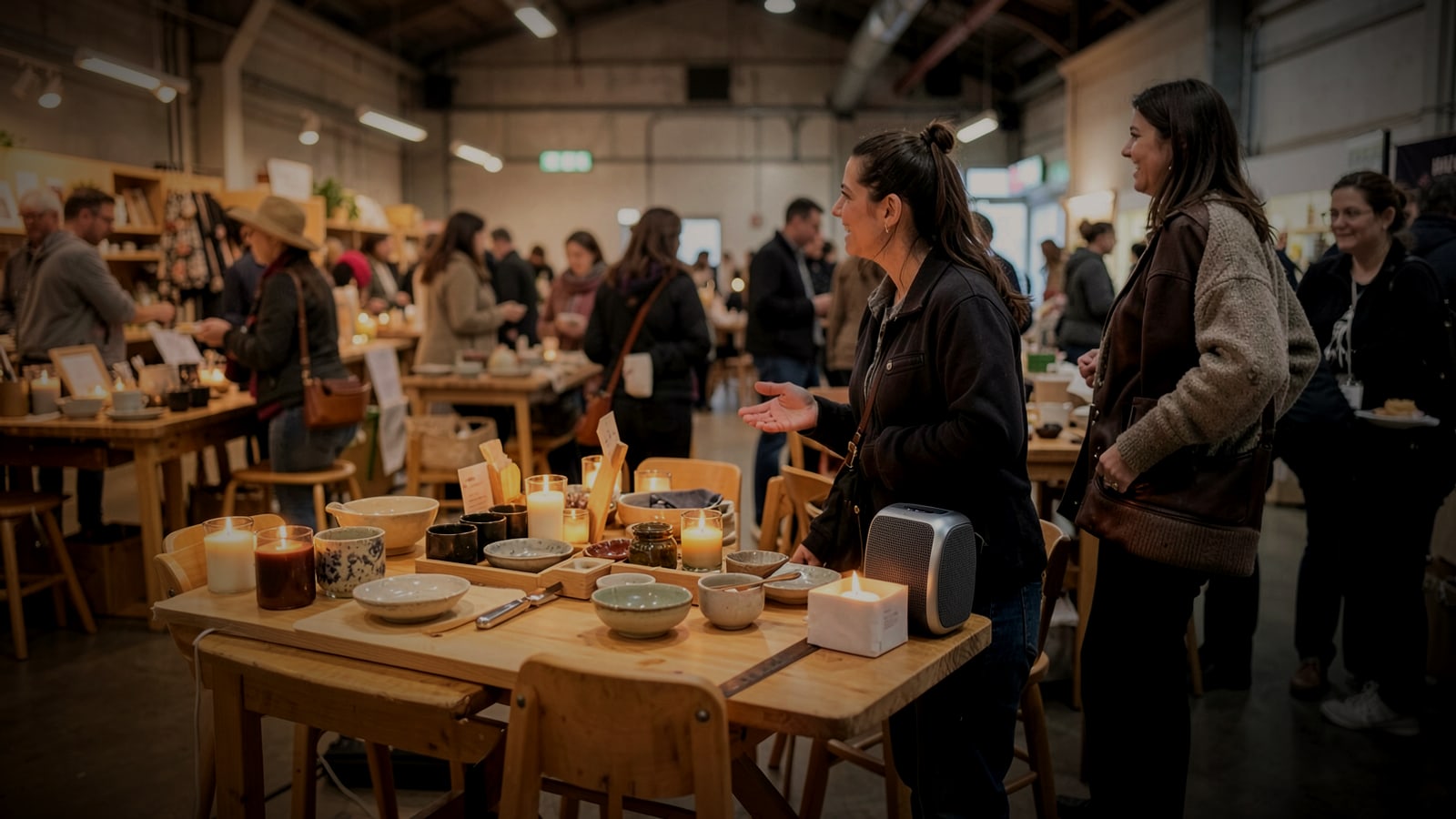
A pop-up shop lasts a weekend or a season, but the music rules are the same as for any store. Here is what pop-up owners, market traders and brands should know about pop-up shop music: licensing, who is responsible at shared markets, portable sound and a setup checklist.
Pop-ups are built to be quick. You sign a short lease, bring in fixtures, stock the shelves and open for a weekend, a month or a holiday season. Music is usually the last thing anyone thinks about, which is why so many pop-ups run on a phone and a Bluetooth speaker. The shop may be temporary, but the rules for playing music to customers are the same as for any permanent store.
This guide covers music for pop-up shops run by independent sellers, brands running temporary retail, and traders at markets and fairs: how licensing works for a short-term space, who is responsible when many sellers share a venue, what to consider with portable sound, and a checklist you can run before opening day.
Why pop-up shop music matters
A pop-up has a few seconds to explain itself. Most customers have never been inside before and may not know the brand. Music is one of the fastest ways to set expectations: calm and considered for a craft or design pop-up, bright and energetic for streetwear, warm and festive for a holiday market.
Temporary spaces also tend to be acoustically rough. Empty retail units have bare walls and hard floors. Market halls are loud and echoey. Outdoor stalls compete with traffic and neighbors. Good music at the right level makes a raw space feel intentional.
Do pop-ups need a music license?
Generally, yes. The length of the lease does not change what the music is doing. Under U.S. copyright law, performing a work "publicly" includes performing it at a place open to the public (17 U.S.C. 101). A pop-up shop open to shoppers is such a place, even if it is only open for two days.
That means the music you play generally needs a public performance license, just as in a permanent store. Our guide on whether you need a license to play music in your business explains the basics, including the organizations that license songs and the narrow exemptions that exist.
Consumer streaming apps do not solve this. They are licensed for personal use, and our guide can I play Spotify in my store explains why that matters.
Who is responsible at markets and shared venues?
Market stall music raises the same questions as a pop-up, with one extra layer: other people's music. Pop-ups often happen inside someone else's space: a market hall, a mall atrium, a hotel lobby, a festival site or a department store concession. Music responsibility depends on who plays what.
- The venue plays music across the whole space. The operator of that sound system is usually the one who needs to license it. Ask them.
- You play your own music at your stall or unit. You are adding a performance of your own, so you need a source that is licensed for it.
- The organizer runs a music program, such as a DJ or live bands at a market. That is typically licensed as part of the event, but confirm it with the organizer.
If you are a trader, ask the organizer three questions before the event: is there venue-wide music, are traders allowed to play their own, and are there volume rules? Many markets ban or limit stall music simply because dozens of speakers competing with each other make the space unbearable.
Music license for events vs a pop-up shop
Some pop-ups are really events: a launch party with a DJ, a night market with live performers, a brand activation with a stage. These are often licensed differently from background music in a shop. A background music license, including a business music service, usually covers recorded background music at a specific location, not a DJ set, a live band or a ticketed program.
If your pop-up includes an event element, treat it as a separate item on your checklist. Ask the venue whether it already holds licenses that cover live performance, and check what your own music source covers.
What happens if you ignore it
Most small businesses that play unlicensed music first hear about it from a licensing organization that offers a license. If a dispute does reach court, the Copyright Act allows statutory damages of 750 to 30,000 dollars per work infringed, and up to 150,000 dollars per work where the infringement is found to be willful (17 U.S.C. 504). A short-term shop is not exempt from that because it is short-term.
This is not meant to scare anyone. It is a reason to sort out music before opening, when it takes an hour, rather than afterward.
Choosing temporary store music
Once licensing is settled, choose music that matches the concept and the space.
- Write a one-line brief. For example: "Bright, confident, current, instrumental-heavy, moderate volume."
- Match the product. A candle and ceramics pop-up needs calm, warm music. A sneaker drop can take more energy.
- Think about duration. A weekend pop-up can use a shorter rotation. A holiday pop-up running for six weeks needs enough variety that staff are not hearing the same songs every day.
- Plan for peaks. Opening hours and launch moments bring crowds. Raise the volume slightly for the rush and bring it back down.
Our page on music for retail stores shows how different kinds of shops use mood and tempo, and most of it applies to pop-ups.
Choosing a portable speaker for business use
Many pop-ups rely on a portable speaker for business use. That is fine if it is set up properly.
- Use a dedicated device, such as a tablet that stays in the shop, not a staff member's phone that leaves with them at lunch.
- Choose even coverage over volume. Two small speakers placed apart usually sound better than one large speaker turned up.
- Keep speakers away from the till so staff can hear customers.
- Charge everything overnight or run it from mains power. A speaker dying at the busiest hour is a common pop-up story.
- Respect neighbors. In shared spaces and outdoors, keep the level low enough that it does not spill into other stalls.
How WeavyAudio fits a pop-up
WeavyAudio is a business music service with an original catalog owned by WeavyAudio. A subscription includes a license to publicly perform the catalog at the registered location, as set out in section 3 of our terms. For a pop-up, that means registering the pop-up's address as your location. The license covers background music there, not DJs, live bands, other music sources or using the tracks in social videos. Pricing is one flat fee per location, and you can cancel when the pop-up ends.
Pop-up shop music checklist
- Ask the venue or organizer about venue-wide music, trader music and volume rules.
- Decide whether you will play your own music and from which licensed source.
- Treat DJs, live music and launch events as separate licensing questions.
- Write a one-line music brief that matches the concept.
- Set up a dedicated playback device and speakers with even coverage.
- Test volume at the till and at the edge of your space.
- Keep a copy of your license or subscription details on site.
When you are planning your next pop-up, you can see the plans.
FAQ
Do pop-up shops need a music license?
Generally yes. A pop-up is open to the public, so playing music there is a public performance, however short the lease. Use a licensed business music source or the appropriate licenses.
Can I play music at my market stall?
Ask the organizer first. Many markets have rules on stall music and volume. If you are allowed to play music, it needs to come from a source licensed for business use, as with any shop.
Does a background music license cover a launch party with a DJ?
Usually not. Background music licenses typically cover recorded background music at a location, while DJs, live music and event programs are licensed separately. Check with the venue and your music provider.
Can I use a Bluetooth speaker and my phone in a pop-up?
The equipment is fine, but the music source matters. Personal streaming accounts are licensed for personal use, not for playing to customers. This is general information, not legal advice.