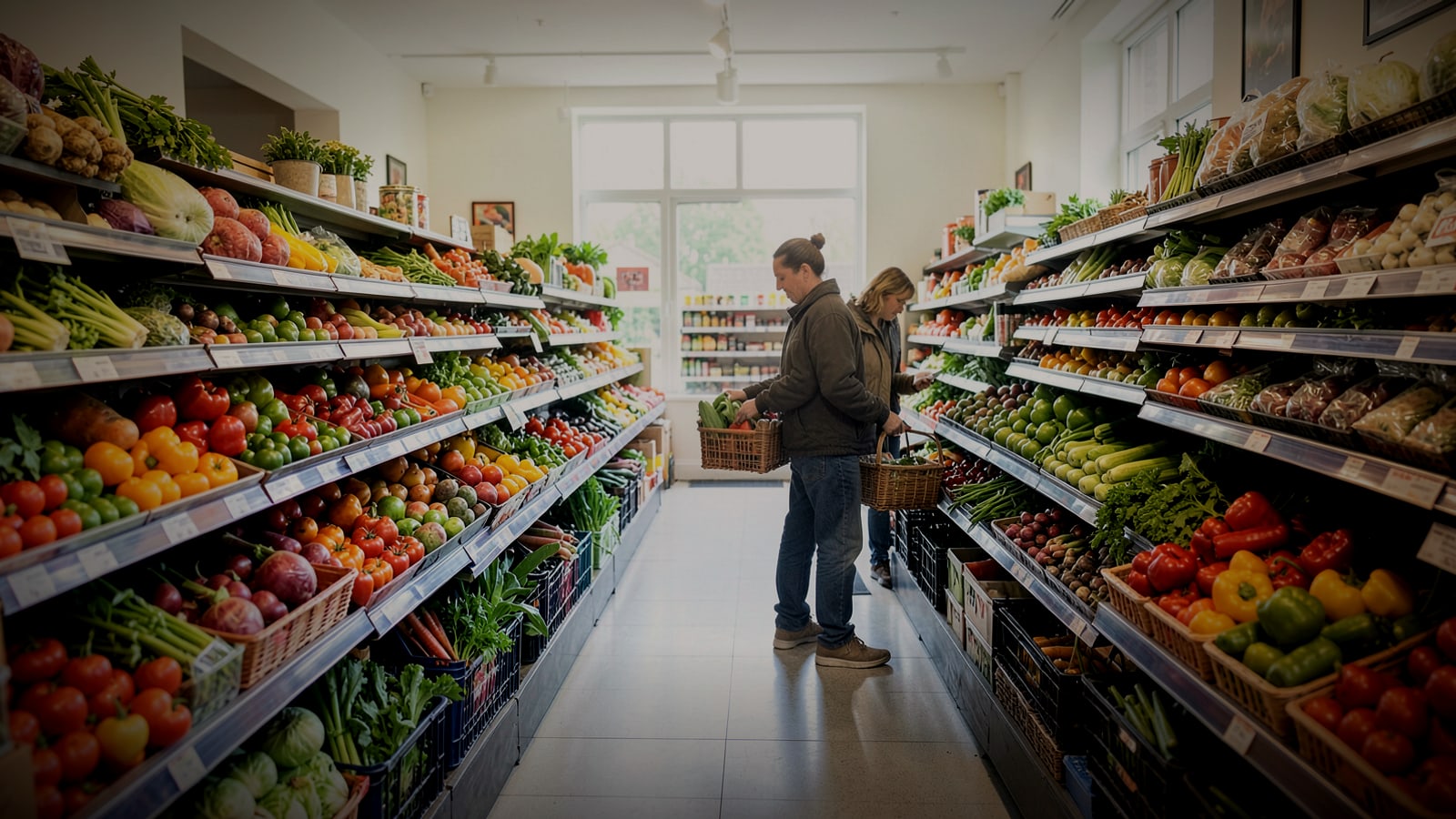
Supermarket music is heard by more people for more hours than almost any other business soundtrack. Here is what the research says about tempo and product choice, a zone plan from produce to checkout, how to handle PA announcements and quiet hours, and what to check on licensing.
Grocery store music has an unusual job. It plays for twelve to twenty-four hours a day, to shoppers of every age, in a building full of refrigeration hum, beeping scanners and overhead announcements. Staff hear it for entire shifts. Customers range from someone grabbing milk in four minutes to a family doing a weekly shop for an hour. And the research on supermarket music is some of the oldest and most cited in the field.
This guide turns that research into practical decisions about music for grocery stores: which tempos to use and when, how to treat each zone of the store, how to handle PA announcements and quiet hours, and what to check on licensing.
What the research says about supermarket music
Two classic studies were run in real supermarkets, and both still shape how retailers think about sound.
Tempo changes pace. In a study published in the Journal of Marketing in 1982, Ronald Milliman varied the tempo of background music in a supermarket over several weeks (doi.org). Shoppers moved more slowly through the store on slow-tempo days, and daily sales volume was higher than on fast-tempo days. Our research roundup on how music affects sales walks through the numbers.
Style can nudge choice. North, Hargreaves and McKendrick played French and German music on alternate days next to a wine display in a supermarket, published in the Journal of Applied Psychology in 1999 (doi.org). French wines outsold German ones on French-music days, German wines did better on German-music days, and shoppers asked afterward did not seem aware that the music had influenced them.
Both studies are decades old, each ran in a single store, and neither tells you what will happen in yours. What they do support is a simple principle: in-store music tempo and style are not neutral. A relaxed tempo encourages a relaxed pace, and music that fits a product or department can reinforce it. That is reason enough to choose deliberately rather than leave the radio on.
Tempo: when to slow down and when not to
Slow music is not always the answer. A grocery store has two kinds of time:
- Browsing time: produce, bakery, deli, wine and specialty aisles, where a calmer pace can mean more discovery and a more pleasant trip.
- Flow time: peak hours, checkout lanes and the parking lot at 5:30 p.m., when customers want to get through quickly and a crowded store needs to keep moving.
A practical approach is relaxed, mid-tempo music for most of the day, slightly more lift during the after-work rush, and never anything so slow or sleepy that the store feels empty. Our mellow mood collection is a good base for all-day background music for supermarkets: warm, unhurried tracks with rounded bass and relaxed vocals. The retail stores hub has more options for shop floors.
A zone plan for grocery stores
Many stores have one audio system and one feed, but even then you can think in zones and adjust speaker levels or taps accordingly. Stores with a zoned system can go further.
Entrance and produce
First impression. Fresh, warm and bright, at a moderate level. This is where your store announces what kind of place it is.
Center aisles
The quietest acoustic area in many stores, and the one where music is most noticeable. Keep levels low and consistent so the sound does not jump as people turn the corner from a noisier department.
Deli, bakery and prepared foods
Staff take orders across a counter here, often through masks, glass and machinery noise. Music near service counters should be noticeably lower so orders are heard the first time. If you have café seating, it can take a little more warmth, like a small coffee shop.
Wine, beer and specialty
This is where the wine study applies most directly. If you run a tasting, a regional promotion or a holiday display, music that fits it is worth considering, as long as it does not clash with the rest of the store.
Pharmacy
Keep music low or off near the pharmacy counter. Customers are discussing medications, and a pharmacist should never have to raise their voice. A low, steady level nearby can help mask conversations from people waiting in line.
Checkout
Lines are where time drags. A steady, pleasant level helps, but the priority is that cashiers and customers can hear each other without leaning in. Self-checkout voice prompts also need to be audible over the music.
PA announcements and music
Overhead pages are part of running a grocery store: price checks, cleanup calls, pharmacy pickups. Some good habits:
- Duck the music during pages if your system supports it, instead of shouting over it.
- Keep announcements short and infrequent. Every page interrupts every shopper in the building.
- Balance the volume. Pages should not be much louder than the music. A jump in level is jarring.
- Record promotional messages carefully. A few well-placed messages are fine; a message every three songs makes the whole store feel like a commercial.
Quiet hours and sensory-friendly shopping
Some grocery chains have introduced sensory-friendly or quieter shopping hours, with music turned off or down and lights dimmed, for shoppers who find noise overwhelming, including many autistic people. Even if you do not formalize it, consider a regular quiet hour on a weekday morning and advertise it clearly. It costs almost nothing, and it tells a whole group of customers they are welcome.
Staff and overnight crews
Your staff hear the music far more than any customer does. A rotation that repeats every few hours will wear people down within a week. Refresh it regularly, and keep enough variety that the same tracks are not heard by the same shift every day. Overnight stocking crews can often have a different, more energetic feed, as long as it switches back before the doors open.
A daily grocery store playlist schedule
- Opening to mid-morning: calm and warm. Early shoppers are often older customers and quick-trip shoppers.
- Late morning to early afternoon: relaxed, steady, mid-tempo. Your main browsing time.
- Late afternoon rush: a small lift in tempo to keep energy and flow up, with volume unchanged.
- Evening: warm and relaxed again as the store empties out.
- Overnight: staff-only feed or off, depending on your operation.
- Seasonal: add holiday music in measured doses; staff fatigue sets in fast. Our retail store music guide covers seasonal rotations in more detail.
Licensing grocery store music
This section is general information, not legal advice.
A supermarket is a place open to the public, so playing copyrighted music there is a public performance that requires permission from the rights holders. Most supermarkets are far over the size threshold of the limited exemption for broadcast radio and use more speakers than it allows, and personal streaming accounts are licensed for personal use only.
The options are licenses from the performing rights organizations that represent the songs you play, or a business music service that licenses its own catalog. WeavyAudio's catalog is original, and a subscription includes a license to publicly perform it at your registered location, as described in section 3 of our terms. Subscriptions are per location. The license covers background playback of our music at that store; in-store advertising, phone systems and any other music source need their own look.
Checklist for grocery store music
- Choose a relaxed, mid-tempo base and a slightly livelier after-work setting.
- Lower levels at service counters, the pharmacy and checkout.
- Make PA announcements duck the music and keep them short.
- Pick a weekly quiet hour and advertise it.
- Refresh the rotation so each shift is not hearing the same loop.
- Match music to wine or specialty promotions where it makes sense.
- Confirm your music source is licensed for business use at each store.
If you want a cleared, all-day soundtrack for a store, you can see the plans.
FAQ
What is the best music for a grocery store?
Relaxed, mid-tempo music with a warm sound and clean lyrics suits most supermarkets for most of the day. Add a little more lift during the after-work rush and keep levels low near service counters and the pharmacy.
Does slow music make people spend more in supermarkets?
In a 1982 supermarket study, shoppers moved more slowly and daily sales were higher on slow-tempo days than on fast-tempo days. It was one store decades ago, so treat it as a useful principle, not a guarantee.
Should grocery stores have quiet hours?
A weekly quiet hour with music off or low is an easy, inexpensive way to welcome shoppers who find noise and bright lights overwhelming. Some chains already offer sensory-friendly hours.
Do grocery stores need a license to play music?
Yes, playing copyrighted music in a store open to the public generally requires a license, and most supermarkets exceed the size and speaker limits of the small-business radio exemption. This is general information, not legal advice.
How often should a supermarket change its playlist?
Often enough that staff do not hear the same loop every shift. A long rotation refreshed regularly works better than a short playlist on repeat.