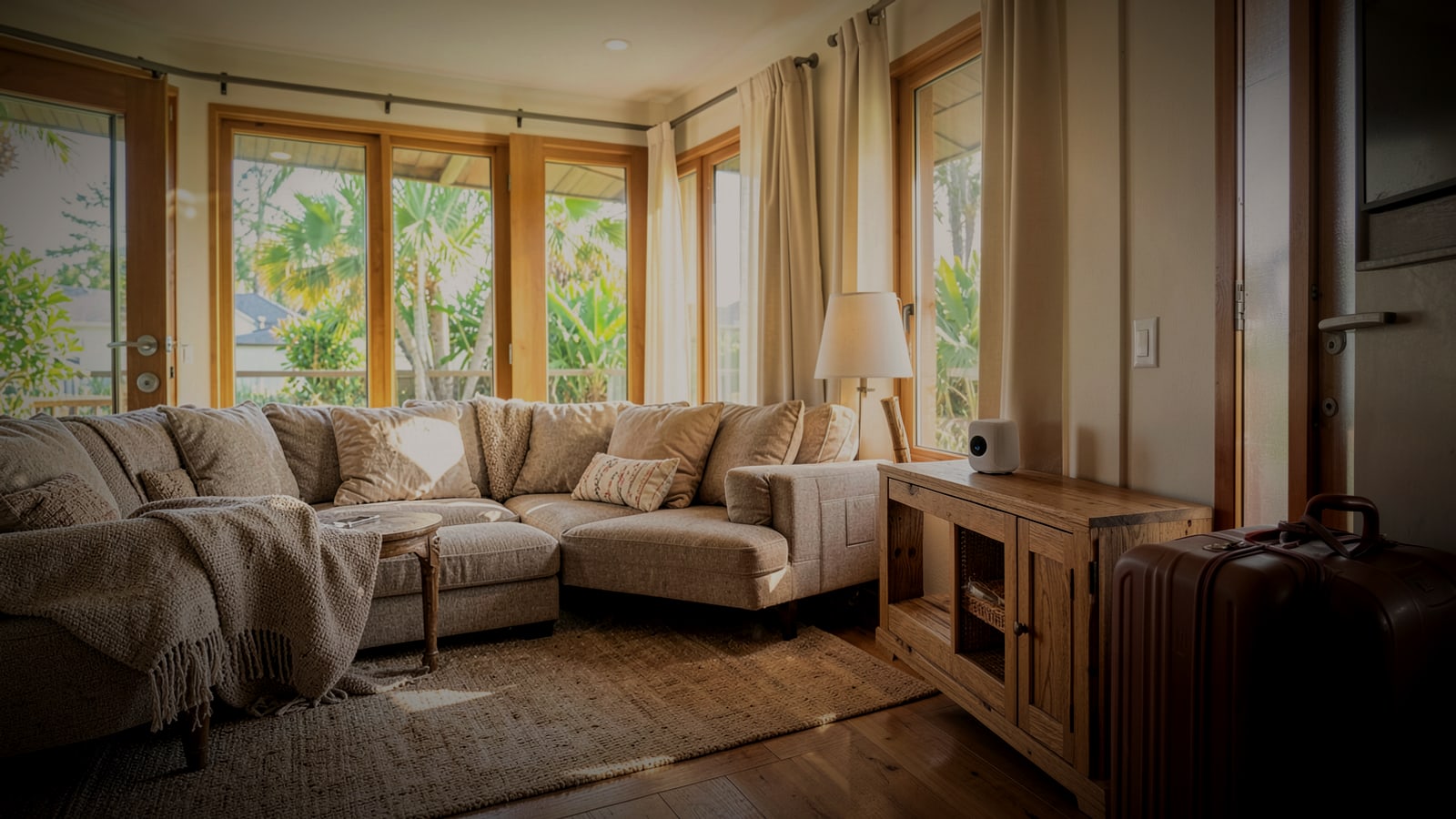
Guests love a rental that sounds as good as it looks, but host-provided music raises real questions: whose account, which rooms, and when a private stay turns into a public space. Here is how to think about music for Airbnb and vacation rentals, plus a setup checklist.
A good speaker has become as standard in vacation rentals as fast Wi-Fi and a decent coffee maker. Guests expect to walk in, connect a phone and fill the place with their own playlist. Many hosts go further and leave music playing for check-in, put a smart speaker in the living room or run background music in a shared lounge. Music for Airbnb stays is a small detail that shows up in reviews, but it also raises questions most hosts never ask: whose streaming account is playing, which rooms count as private, and when does a rental start to look like a hotel lobby?
Airbnb host music licensing is rarely covered in hosting guides. This one separates the easy cases from the grey ones, explains why the answer changes between a whole-home rental and a guesthouse with shared spaces, and ends with a practical setup checklist. It is general information, not legal advice. If your property is large, commercial or unusual, talk to a lawyer who works with copyright or hospitality clients.
Why music for Airbnb is not one question but three
Hosts tend to ask "can I play music in my Airbnb?" as if it had one answer. In practice there are three different situations, and they sit at different points on the legal and practical spectrum.
- Guests play their own music on their own devices. They connect a phone to a Bluetooth speaker you provide and stream from their own account.
- You provide the music in a private rental. A smart speaker linked to your account sits in the living room, or music plays when guests arrive.
- You play music in shared or public areas. A guesthouse lounge, a breakfast room, a pool deck shared by several units, a reception desk or an event space you rent out.
The further down that list you go, the more your rental starts to resemble a hospitality business, and the more the rules for businesses apply.
Public vs private performance: the rule that decides it
U.S. copyright law gives songwriters and publishers the exclusive right to perform their music publicly. The key definition sits in 17 U.S.C. 101: a performance is public if it happens at a place open to the public, or at any place where a substantial number of people outside a normal circle of family and social acquaintances is gathered. The same definition also covers transmitting a performance to the public, even when people receive it in separate places or at different times.
Apply that to the three situations above.
- A family or group of friends renting a whole home is, for the length of their stay, a normal circle of family and social acquaintances. Music they play for themselves in that home looks much more like a private performance than a public one.
- A lounge, breakfast room or pool area shared by guests from several different bookings is a gathering of people who are not one social circle. Music there starts to look like music in a small hotel.
- A reception area or event space open to people who are not staying with you is a place open to the public, and music there is plainly a public performance.
Where exactly a small guesthouse crosses the line is not something a blog post can settle. How courts treat music reaching individual guest rooms can also depend on how it gets there. What is clear is the direction of travel: the more your property works like a hotel, the more you should treat music like a hotel does.
Personal streaming accounts and smart speakers
The second issue has nothing to do with copyright statutes and everything to do with the account you are using. Consumer streaming subscriptions are sold for personal, non-commercial listening. We cover that in detail in our post on whether you can play Spotify in your store, and the same reasoning applies to a rental property run as a business.
That matters in two ways for hosts.
- A smart speaker in Airbnb homes linked to your personal account is a grey area. A guest asking it to play a song is closer to personal use, but you are providing your personal subscription as an amenity of a paid rental. Check the terms of your streaming service before you do this.
- Background music in a shared lounge or breakfast room from your personal account is the clearest problem. That is exactly the commercial use consumer plans exclude.
There is also a practical side. A smart speaker linked to your account can expose your listening history, playlists, shopping lists or voice purchases to strangers, and it can be used to change settings. A guest could reorder groceries on your account, fill your recommendations with their party playlist or connect the speaker to a different network.
The safest setup for a whole-home rental
For most whole-home rentals, the cleanest option is also the simplest: provide good hardware and let guests bring their own music.
- Bluetooth speaker, not a linked smart speaker. Guests pair their own phone and stream from their own account. Nothing of yours is exposed.
- A clear pairing card. Put the speaker name and pairing steps in the house manual and on a small card next to the speaker, so guests do not have to message you to figure it out.
- Reset between stays. Clear the paired device list during turnover so the next guest does not find the previous one's phone reconnecting.
- Set a volume limit if the speaker supports it. Loud music is one of the easiest ways to turn neighbors against a short-term rental, and many local short-term rental rules include noise limits.
- Mention quiet hours in the listing and the house rules. State them in plain numbers, for example 10 p.m. to 8 a.m., and match your local ordinance or homeowners association rules.
- Skip the welcome playlist from your own account. If you want music playing on arrival, use a source you are licensed to use for a business, or leave the room quiet and let the guest choose.
Guesthouses, B&Bs and rentals with shared spaces
Once you have a shared lounge, breakfast room, courtyard or reception desk, you are running something closer to a small lodging business, and background music becomes part of your service rather than your guests' personal choice. That is the point where a source licensed for business playback makes sense.
A few practical points on background music for guesthouse common areas:
- Choose calm, low-key music for breakfast and check-in. Guests are tired, jet-lagged or talking to you about directions. Instrumental or soft vocal tracks work far better than a busy pop playlist.
- Keep it out of sleeping areas. Music belongs in shared spaces during the hours those spaces are used, and never in hallways next to bedrooms late at night.
- Automate the on and off. Music should start with breakfast service and stop when the lounge closes, not run all night because nobody switched it off.
- Mind outdoor areas. A pool deck or garden speaker carries much further than you think, especially after dark.
Our music for hotels page covers the same logic at a larger scale: lobbies, breakfast rooms and lounges each need a different mood. For the licensing background behind all of this, see do I need a license to play music in my business, which explains how public performance rights and PROs work.
A host checklist for vacation rental music
Work through this list once, then again whenever you add a room, a shared space or a new device.
- List every place music can play: bedrooms, living room, kitchen, outdoor areas, shared lounges, reception.
- Mark each one as private to a single booking, shared between bookings, or open to non-guests.
- For private spaces, provide a Bluetooth speaker and pairing instructions, and let guests use their own accounts.
- For shared or public spaces, use a music source licensed for business playback at that location.
- Unlink any personal streaming or shopping account from devices guests can reach.
- Set speaker volume limits and publish quiet hours in the listing and house rules.
- Add "reset speaker pairing" to your turnover checklist.
- Keep a copy of your music license or subscription terms with your property records.
Where WeavyAudio fits
WeavyAudio is a streaming service for businesses with an original catalog, so there are no PRO invoices for the music it plays. Our terms grant a license to publicly perform the catalog at the registered location and describe permitted use as background music playback at that location during operating hours. It is built for businesses rather than for private listening, so it fits guesthouses, B&Bs and rentals with shared lounges or breakfast rooms, not a whole-home rental where guests stream their own music. If that describes your property, you can see the plans and check that the terms match how you use the space.
FAQ
Can I leave a smart speaker in my Airbnb?
You can, but a Bluetooth speaker that guests pair with their own phones is simpler and safer. A smart speaker linked to your personal account exposes your data and, because the rental is a business, raises questions under your streaming service's terms.
Do vacation rental hosts need a music license?
For a whole-home rental where guests play their own music, usually not. For shared lounges, breakfast rooms or areas open to non-guests, music is much closer to a public performance, and a source licensed for business playback is the safe choice. This is general information, not legal advice.
Can guests play their own music in my rental?
Yes. A family or group renting a whole home and playing music on their own devices for themselves is the least problematic case. Your job is to provide good hardware, clear pairing instructions and quiet hours.
What music works best in a guesthouse breakfast room?
Calm, low-volume music with few vocals, such as soft acoustic, light jazz or chill instrumental tracks. It should cover the clink of cutlery and quiet conversations without competing with them, and it should stop when breakfast ends.