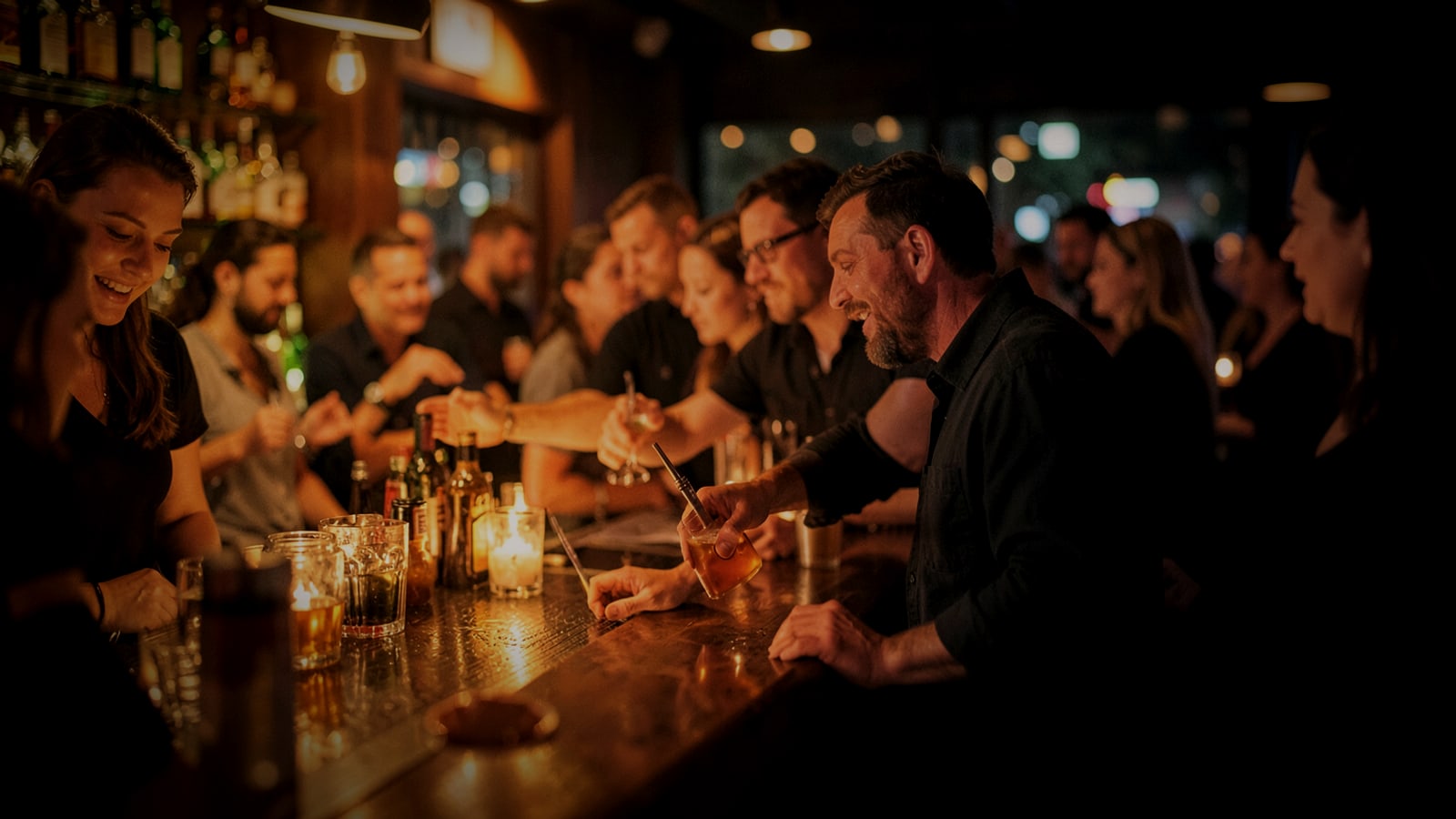
A good bar playlist is not a list of favorite songs. It is a plan for the night: quiet enough to talk at six, lively at ten, and winding down before last call. Here is an hour-by-hour arc, advice for each bar format, and what research says about tempo, volume and drinking.
Every bar has two playlists, whether it planned them or not: the one the owner imagines and the one guests actually hear at 6 p.m. on a quiet Tuesday. The gap between them is where most bar music goes wrong. A track that sounds great in a packed room at eleven can feel like a party for nobody when three people are sitting at the rail.
A good bar playlist is a plan for the night rather than a list of favorite songs. This playbook gives you an hour-by-hour arc, specific advice for different bar formats, what research says about tempo and volume, and a simple routine to keep the music fresh without it becoming a second job.
Start with three questions
Before you choose a single track, answer these:
- What do guests come for? Conversation, watching a game, meeting people or dancing all call for different music.
- When is your real peak? Many bars are busiest earlier or later than the owner assumes. Check your sales by hour.
- Who is working? Bartenders hear the playlist for eight hours. If they hate it, it will quietly get changed.
With those answers, you can design an arc instead of pressing shuffle.
The nightly arc
Tempo ranges below are rough guides in beats per minute; trust your ears and your room.
- Opening, roughly 4 to 6 p.m.: keep it low-key and warm, around 90 to 110 BPM. The room is nearly empty, and music should make it feel calm rather than abandoned.
- Happy hour: brighter and more social. Mellow afrobeats, soulful grooves and light house around 105 to 120 BPM work well while people arrive and talk.
- Dinner overlap: if you serve food, keep vocals low in the mix and the volume modest. Warm deep house around 118 to 124 BPM sits comfortably under conversation.
- Prime time: build gradually. Raise the energy with fuller house grooves, afro house and, for the right crowd, reggaeton and Latin pop. Let volume rise less than the crowd noise does.
- Late night: this depends on format. Cocktail bars often go deeper and moodier rather than louder; neighborhood bars may move toward hip-hop and pop.
- Last call: step the tempo and volume down over twenty to thirty minutes. Music is one of the gentlest ways to tell a room the night is ending.
A ready-made starting point for the early and dinner-overlap hours is our mellow mood collection, which mixes mellow house, afro house and slower grooves.
Music by bar format
Cocktail bars and lounges
The drinks are the show, so the music should feel considered but never loud. Deep, rolling grooves, understated vocals and a steady mid-tempo pulse suit most cocktail rooms. Keep volume at a level where guests can talk to the bartender without leaning in, and change the mood in small steps as the night goes on.
Wine bars
Wine bars reward restraint. Aim for warm, softer tracks, slower tempos and plenty of space in the sound. If your crowd skews toward dinner and conversation, keep electronic material at the mellow end and resist the temptation to build a late-night peak the room does not want.
Sports bars
When a game is on, the TV audio usually wins, and music should either stop or sit well underneath. Between games and after the final whistle, upbeat pop, hip-hop and house keep the energy up. Decide in advance who controls the switch so staff are not arguing about it during a close finish.
Neighborhood and dive bars
Familiarity is often the point. If regulars expect singalong classics and a jukebox full of hits, you need a service that licenses mainstream music, plus the performance licenses that go with it. An original catalog still works well for the early hours and quiet nights, when you want atmosphere rather than a singalong.
Hotel bars
Hotel bars sit between lobby and night out. Guests range from business travelers answering email to couples starting an evening. Refined, mid-tempo grooves that shift slowly from afternoon to late evening suit most of them.
Latin and Afro nights
Themed nights work best when the whole evening commits. Afrobeats and afro house bring a warm, rolling energy that suits both early evening and peak hours; our afrobeat collection is a good place to start. Reggaeton-heavy sets are better saved for later, when the crowd is ready for it.
What research says about tempo, volume and drinking
Bar owners often ask whether music changes how much people drink. A few studies have looked at it, and they are worth knowing precisely.
In a field experiment published in 2008 in Alcoholism: Clinical and Experimental Research, Nicolas Guéguen and colleagues observed 40 male beer drinkers in two bars (PubMed). Patrons exposed to a high music level drank more and took less time to finish each glass than those exposed to the bars' usual level. The authors discuss arousal and the effect of loud music on conversation as explanations.
In restaurant research, which we summarize in How Music Affects Sales, slower music has been linked to longer stays and higher bar spending, while faster music supported quicker turnover.
These are small, specific studies, not universal laws. The responsible takeaway is not to crank the volume to sell more drinks. Use tempo and volume to shape the energy of the room, keep levels where people can still talk, and leave decisions about how much anyone drinks to trained staff.
Details that separate good bars from great ones
- Build dayparts, not one giant playlist. Three or four blocks of a few hours each are easier to manage and sound more intentional.
- Watch transitions. A slow, moody track followed by a peak-time banger sounds like a mistake. Order matters within each block.
- Decide your explicit-lyrics rule. Many bars are relaxed about it late at night but not during happy hour or when food is served. Write the rule down.
- Zone the space. A patio, a dining area and the bar rail rarely want the same music or the same volume.
- Listen from the stools and the booths. Speakers above the bar can make the room sound louder to staff than to guests, or the reverse.
- Keep a skip list. Staff should be able to flag tracks that grate, and someone should act on it every week.
A simple monthly routine
- Week one: review staff feedback and the skip list; remove anything flagged.
- Week two: refresh a fifth of each daypart with new tracks.
- Week three: check volume at peak with the room full, from a seat rather than behind the bar.
- Week four: plan any themed nights or seasonal changes for the next month.
Keep the licensing straight
Background music is only one part of a bar's licensing picture. Jukeboxes, live bands, DJs and TVs can each involve their own permissions, and we break down the main performing rights organizations in ASCAP, BMI, SESAC and GMR Fees Explained for Restaurants and Bars. An original catalog licensed for venue play covers the background music without separate PRO invoices, but it does not cover music from other sources. This is general information, not legal advice.
If you want to try this arc in your own room, you can start a WeavyAudio free trial and build your dayparts from the catalog in an afternoon.
FAQ
What is the best music for bars?
It depends on the format. Cocktail bars and lounges usually suit deep, mid-tempo grooves; sports and neighborhood bars suit upbeat pop and hip-hop between games; wine bars suit softer, slower tracks. Plan by hour rather than by genre alone.
What tempo should bar music be?
A common arc runs from about 90 to 110 BPM at opening, through 105 to 120 during happy hour, to fuller grooves around 120 to 126 at peak, then back down before last call. Adjust to your crowd.
How loud should music be in a bar?
Loud enough to feel lively, quiet enough that guests can order and talk without shouting. Research has linked louder music with faster drinking, so keep levels sensible and check them from where guests sit.
Should a bar play explicit lyrics?
Many bars allow them late at night but not during happy hour, food service or daytime. Set a written rule so every shift follows the same standard.
Can I build a bar playlist from my personal Spotify account?
No. Personal streaming accounts are licensed for personal, non-commercial use. Use a service licensed for business playback and confirm what else, such as TVs or live music, needs its own license.